
8 min read
A supplier scorecard is a regular, weighted assessment of how a supplier performs against the measures that matter most to the business, usually covering quality and delivery alongside cost and responsiveness. A useful scorecard draws on input from more than one team and becomes the agenda for performance conversations with the supplier.
Most procurement teams already have some version of a scorecard. The harder question is whether it tells the truth. When I invited Shayan Farshid onto the Art of Procurement podcast, he described a familiar contradiction: a supplier that looks healthy on the quarterly scorecard while planners and production teams absorb constant date changes. Closing the gap between the score and the experience starts with the scorecard's design. Who contributes to it and what happens after it is published matter just as much.
Key Takeaways
- A supplier scorecard turns supplier performance into a short list of weighted measures that procurement reviews with the supplier on a regular cycle.
- The measures should reflect what the business values. A scorecard built only on what is easy to count can show a supplier as healthy when the business experiences something different.
- On-time delivery measured against the supplier's latest committed date can hide commitment dates that drift away from the date the business originally needed the material.
- Input from the teams who deal with the supplier every day, including accounts payable, gives a fuller view of what a supplier costs to work with than procurement's own data can provide.
- A scorecard creates value when each review ends with agreed actions that have an owner and a due date and are checked at the next review.
What is a supplier scorecard?
A supplier scorecard is a structured tool procurement uses to rate a supplier's performance over a set period against agreed measures such as quality and on-time delivery. Each measure is scored and weighted to produce an overall result, which procurement and the supplier review together to decide what should improve.
Scorecards are usually reserved for strategic and critical suppliers and updated monthly or quarterly. They are one tool within supplier performance management, the broader discipline of setting expectations, measuring results, and managing underperformance. They are also different from a balanced scorecard for procurement, which measures the procurement function's own performance instead of an individual supplier's.
What should a supplier scorecard measure?
Most supplier scorecards share four core categories: quality, delivery, cost, and responsiveness/customer service. Many add risk and sustainability. The individual metrics within each category, from defect rate to total cost of ownership, are defined in our article on supplier performance management metrics.
Choosing the categories is the easy part. Deciding which ones carry the most weight is where the scorecard either reflects the business’s experience or drifts away from it.
"If the business is focused on margin and improving their margins and cost, etc., then you ought to see it on the procurement scorecard. At the same time, you ought to see it on your supplier scorecard. So it's all got to be aligned. But if it isn't, it shouldn't be on there."
Chris Sawchuk, then principal and global procurement advisory practice leader at The Hackett
Group (Art of Procurement episode 43, What Are Procurement's Blind Spots and How Can We Address Them?)
The same logic works in the other direction. A business unit that is focused on growth may care more about a supplier's speed to market or willingness to support new product launches than another round of price reductions, and the weightings should show that.

Measure delivery against the date the business needed it
On-time delivery is the measure most scorecards rely on, and it is also the one most likely to give a misleading result. Shayan Farshid found that a supplier can deliver on time against their latest committed date while that commitment moves further and further from the date the business originally needed the material.
"The scorecards are necessary. The argument is whether those chosen measures are telling us the entire story."
Shayan Farshid, procurement and operations professional (Art of Procurement episode 884, Beyond On-Time Delivery: Measuring Supplier Stability)
The cost of that drift rarely shows up in the supplier's score. It appears elsewhere in the organization as planning changes and expediting, and later as escalations and buffer inventory. Shayan's answer was a Supplier Stability Index that adds stability as a fourth dimension to the traditional measures. It grades suppliers from A to F using purchase order line and quality data that most manufacturers already have, including how closely commitments match need dates, how much unresolved delivery exposure is building up, and how critical the affected components are.
What I found particularly interesting is that he made the framework open source, so teams can inspect the logic and adapt it to their own operation. Even without adopting the full index, tracking commitment changes per order alongside on-time delivery gives a far more honest picture of a supplier's reliability.
Who should contribute to a supplier scorecard?
Procurement usually owns the supplier scorecard, but they rarely see the whole relationship. Business users know how responsive a supplier is when something goes wrong. Quality teams see defects and corrective actions, while planners see every date change. Accounts payable sees whether invoices arrive clean or turn into disputes.
Matt Clark, then president and COO of Corcentric, recommended bringing accounts payable into supplier scorecarding so that transaction quality sits alongside procurement's own measures. Combining the two produces what he called a "total supplier value score," and ranking suppliers on it can change which ones look best. Even the supplier with the lowest unit price can be one of the most expensive to work with once billing errors and exceptions are counted.
A short, structured survey that asks each contributing team the same few questions every cycle is usually enough. Long surveys get rushed answers, and rushed answers make the scorecard less reliable than no input at all.
How to build a supplier scorecard in six steps
1. Start with the suppliers that matter most
Scorecarding every supplier creates work without insight. Segment the supply base first, for example with the Kraljic Matrix, and focus scorecards on strategic and bottleneck suppliers, where performance problems cost the business most.
2. Translate business priorities into categories and weights
List what the business needs from this supplier this year, then weight the categories to match. Weights that add up to 100 percent make the tradeoffs visible to everyone, including the supplier.
3. Define every measure before scoring it
Each measure needs a written definition and a named data source. It also needs an owner who answers for the number and a fixed measurement period. "On-time delivery" should state whether it is measured against the need date or the committed date (or both). Agreeing on definitions with the supplier up front prevents most later arguments about the data.
4. Set a scale and the thresholds that trigger action
A one-to-five scale is easy to explain. Decide in advance what score triggers an improvement plan and what score earns recognition, so the result leads to a decision instead of a discussion about what it means.
5. Agree on a review rhythm
Operational measures for critical suppliers can be reviewed monthly, with the full scorecard covered in a quarterly business review. Lower-risk suppliers may only need an annual review.
6. Close the loop with actions
Every review should end with agreed actions, each with an owner and a due date, and the next review should start by checking them. Tracking those actions is what turns the scorecard from a report into a management tool.
A worked example
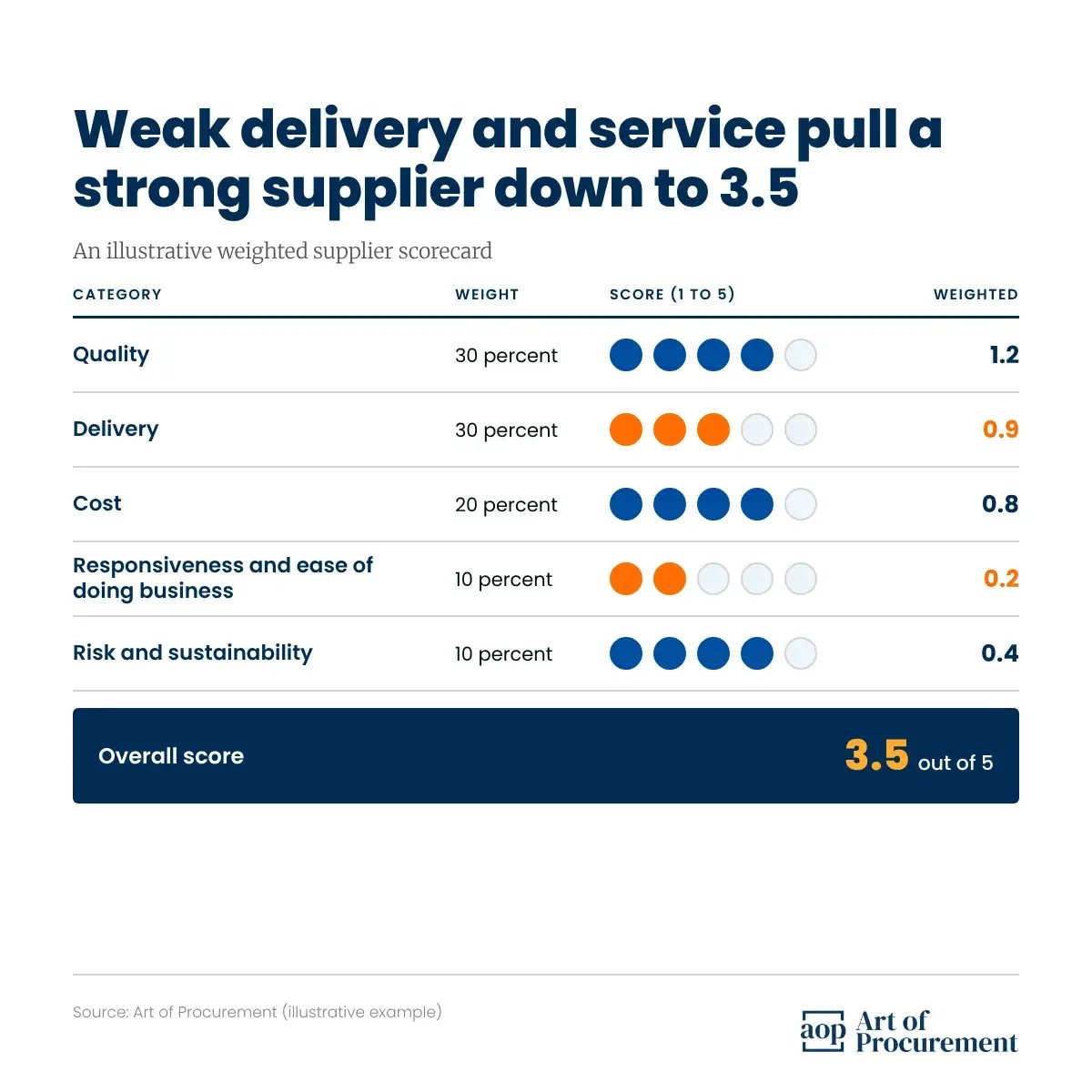
The table below shows how the weights and scores combine for one hypothetical supplier. The weights are illustrative; a business focused on growth would shift weight toward responsiveness and innovation.
|
Category |
Weight |
Example measures |
Score (1 to 5) |
Weighted score
|
|---|---|---|---|---|
|
Quality |
30 percent |
Defect rate, compliance with specifications |
4 |
1.2 |
|
Delivery |
30 percent |
On-time delivery against need date, commitment changes per order |
3 |
0.9 |
|
Cost |
20 percent |
Price compliance with contract, cost reduction ideas delivered |
4 |
0.8 |
|
Responsiveness and ease of doing business |
10 percent |
Issue resolution time, invoice accuracy (input from accounts payable) |
2 |
0.2 |
|
Risk and sustainability |
10 percent |
Financial health, certifications and sustainability commitments |
4 |
0.4 |
|
Total |
100 percent |
3.5 out of 5 |
In this example, a supplier with strong quality and pricing still lands at 3.5, mainly because delivery commitments keep moving and the business finds them hard to work with. Those two lines become the agenda for the next review.
Common supplier scorecard mistakes
Most scorecards that fail do so for the same few reasons:
- Measuring what is easy to count. System data gets used because it is available, even when it does not reflect what the business values.
- Too many measures. A scorecard with 25 metrics gives no clear message about what needs to improve.
- Scoring without discussing. A score that is emailed and never discussed rarely changes anything.
- No consequences either way. Suppliers learn quickly whether a poor score leads to action and whether a strong score earns more business.
Relevant research: In services, the gap often starts in the contract: according to Twin Paradoxes of Services Spend Management, the 2026 Art of Procurement and SAP research report, only 19 percent of procurement teams use bonus or penalty mechanisms for routine services, and 14 percent for activity-driven services. Even when a contract includes KPIs, the supplier usually gets paid either way.
There is also a cost on the supplier side, and it grows with every additional request.
"Suppliers get confused and overwhelmed with similar but different supplier scorecards and surveys, and have to spend resources responding to those requests instead of innovating and improving."
Jason Pearson, then president and CEO of the Sustainable Purchasing Leadership Council (Art of Procurement episode 94, Where to Start in Integrating Sustainability into the Procurement Process)
Jason was describing sustainability requests across many buyers, but the same thing happens inside a single company when different business units send the same supplier their own versions of a scorecard. One agreed scorecard per supplier, with requests limited to data procurement will actually use, respects the supplier's time as well as procurement's.
How to use a supplier scorecard in supplier reviews
The scorecard's real value shows up in the review meeting. A good review uses the scores to open a conversation about causes and next steps, and the supplier should see the scorecard before the meeting so they can come prepared.
"It creates a really good, holistic conversation when procurement goes back to a supplier to say, look, your product is good, we're pretty happy with your pricing, but you're expensive to work with... Then that changes the dialogue with that supplier and it makes it a better, healthier relationship as a whole."
Matt Clark, then president and COO of Corcentric (Art of Procurement episode 240, Bridging the Gap Between Procurement & Accounts Payable)
That conversation works best when it runs both ways. Asking the supplier what makes the buying organization difficult to serve, such as late forecasts or frequent specification changes, often explains part of their score. It also builds the trust that supplier relationship management depends on.
Scorecards are also starting to reach beyond a single company's own experience. Providers such as FlockScore pool anonymized performance data across manufacturers, so a buyer evaluating a new supplier can see how that supplier has performed for peers before signing a contract.
The bottom line on supplier scorecards
The value of a supplier scorecard depends on the questions it was designed to answer. Start from what the business needs from each supplier, measure delivery against the date the material was needed, and bring in the people who live with the supplier day to day, including accounts payable. Then use every review to agree on actions and check them the next time. Built this way, the scorecard becomes one of the clearest ways procurement shows the business that they understand what it values, which is exactly the role of a strategic services business within the business.