
“You don't need an advanced platform to begin. You just need consistent definitions, discipline, to look at the data, and a willingness to move beyond the on-time delivery average to make really good decisions going forward.”
Supplier scorecards are a fundamental part of how procurement manages performance, but like any measurement system, they can only tell us what we have designed them to measure.
A supplier might have strong on-time delivery numbers while the people in production are experiencing something very different. Dates keep moving, planners are adjusting schedules, teams are expediting orders, and the supplier still looks perfectly healthy when the quarterly scorecard comes around.
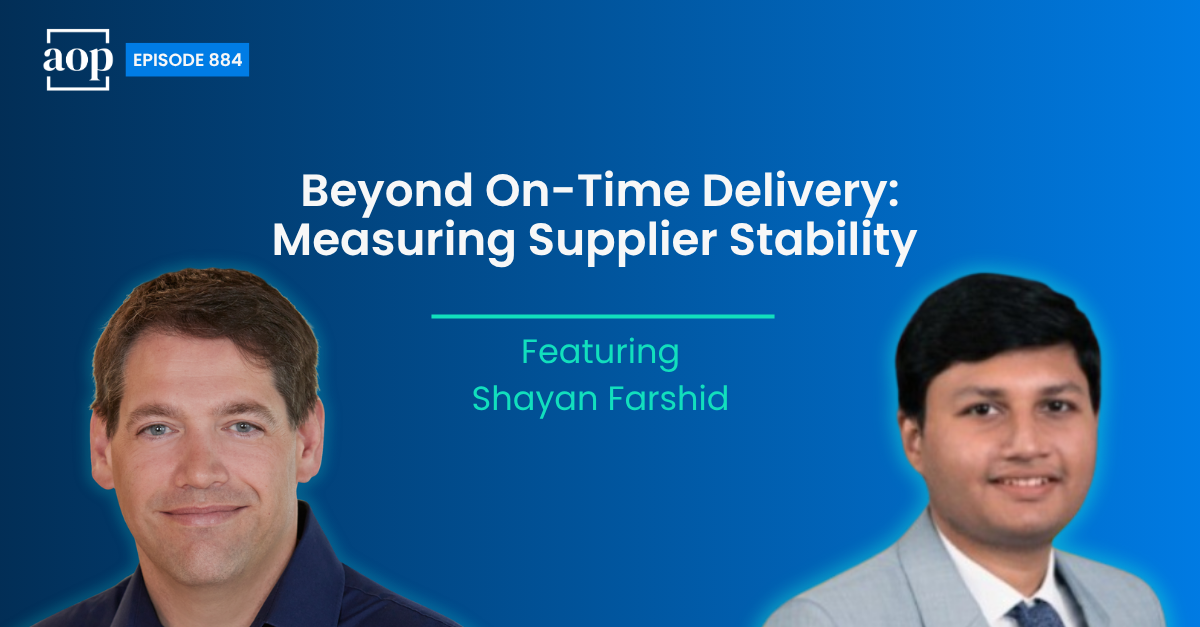
That disconnect is what led Shayan Farshid, a procurement and operations professional, to develop the “Supplier Stability Index,” an open-source framework designed to help teams get a more complete picture of supplier reliability using data they largely already have.
I recently invited Shayan onto the Art of Procurement podcast to talk about what traditional supplier metrics can miss and why better supplier data becomes even more important as we start introducing AI into these decisions.
An incomplete picture
“The scorecards are necessary. The argument is whether those chosen measures are telling us the entire story.”
Shayan wasn't arguing that procurement should abandon the metrics we already use. Cost, quality, and delivery remain fundamental measures of supplier performance. His question is whether those measures give us enough information to understand how dependable a supplier will be going forward.
On-time delivery is a good example. A supplier may technically deliver against its latest committed date while repeatedly pushing that commitment further away from the date the business originally needed the material. The final metric can look healthy even though production has been absorbing the consequences of those changes.
Looking at that movement gives procurement another dimension of supplier performance to consider: not only whether the supplier ultimately delivered, but how much confidence the business can place in the commitments they make along the way.
Supplier instability rarely creates just one problem
“The reason this is very expensive is that it often doesn't show up in the single obvious place we're looking. It shows up ultimately as a cascade of events, like for example, planning inefficiencies, expediting activities, escalations, buffer inventory, and then later on unwanted schedule adjustments and many more.”
A slipping supplier commitment may look relatively minor when viewed as a date change on an individual purchase order, but the cost of that instability is often distributed across the organization.
Planning has to respond. Procurement may need to expedite. Manufacturing schedules change. Inventory decisions get more conservative. People spend time escalating issues that shouldn't have required escalation in the first place.
Those consequences don't necessarily roll neatly back into a supplier's delivery score, which means procurement can underestimate the operational cost of an unreliable commitment. Giving that instability greater visibility creates an opportunity to intervene earlier rather than waiting until the accumulated consequences become impossible to ignore.
Stability adds another dimension to supplier performance
“Stability tells you how much confidence you should have given that those outcomes will continue to support the plan when volume changes, supply tightens, disruptions, or the business might face any sort of disruption.”
Most supplier metrics are understandably grounded in what has already happened. Stability uses that history too, but asks procurement to interpret it through the lens of what the business may be able to rely on next.
That doesn't require procurement to predict the future. It means looking for patterns that tell us whether current performance is as dependable as the headline numbers suggest. If commitment dates are drifting, unresolved orders are accumulating, or problems are concentrated around business-critical components, those are signals procurement can bring into supplier conversations while there is still an opportunity to change the outcome.
Accessibility matters if we want better supplier decisions
“The goal was never for me to say that one universal model can replace procurement judgment. The goal was to offer more of a transparent, accessible starting point that helps teams have a more informed supplier conversations that can ultimately help the business in the long run.”
One of the things I found particularly interesting about Shayan's work is his decision to make the framework open source. Sophisticated supplier risk and analytics platforms can provide capabilities that would have been difficult for procurement teams to imagine a decade ago, but not every organization has the budget or resources to implement them. Small and midsize manufacturers still face the same fundamental consequences when a critical component doesn't arrive.
The Supplier Stability Index starts with purchase order line and quality data that many of those organizations already have. It also leaves room for procurement judgment. Different manufacturing environments have different definitions of criticality and different operating realities. Transparency allows practitioners to understand the logic, challenge the assumptions, and adapt the framework rather than accepting a score they cannot explain.
AI makes strong data foundations even more important
“There can be instances where you can put an AI on top of unclear supplier data, but you'll simply get a faster, more polished version of the same confusion.”
There is enormous interest in using AI to identify supplier risk, interpret data, recommend actions, and eventually automate portions of supplier management. Those capabilities will only become more sophisticated, but sophistication at the technology layer doesn't resolve ambiguity underneath it.
Procurement still needs consistent definitions, disciplined data practices, and a clear understanding of what the information actually represents. If we don't know why a supplier received a particular score or what signals are feeding a recommendation, adding AI doesn't necessarily make the resulting decision more reliable.
Shayan's framework is an interesting reminder that innovation doesn't always begin with adding more technology. Sometimes it starts by looking more closely at information we already have and asking whether the metrics we've relied on are still answering the questions the business needs us to answer.
Links: