
13 min read
If you've spent any time in procurement, you've issued or received an RFP. It is one of the most familiar tools in our profession. But the more I've worked on both sides of the table (first as a buyer, now as someone whose team responds to procurement-led processes), the more I've come to believe that most of us underestimate what an RFP actually is.
An RFP is not just a document. It is an invitation. And once you've extended that invitation, you've taken on a responsibility to the people who accepted it.
In this guide, I want to walk you through how I think about running a responsible, effective RFP process from end to end: what to do before you ever issue one, how to design the evaluation itself, and the one step that most procurement teams skip but shouldn't. I'll also give you a full RFP template you can copy and adapt for your own use.

What is a Request for Proposal (RFP)?
A Request for Proposal is a formal document that procurement issues to a shortlist of suppliers, inviting them to propose how they would solve a specific business problem or deliver a defined scope of work. Unlike a Request for Quote (RFQ), where you already know exactly what you want and are mostly comparing price, an RFP is used when the solution itself is part of what you're evaluating. You want suppliers to bring their thinking, their methodology, their team, and their commercial proposal to the table.
A well-built RFP typically asks suppliers to address scope, technical approach, delivery model, team and qualifications, references, commercials, and contractual terms. The output is a structured response you can evaluate against consistent criteria, with the goal of selecting the supplier whose overall proposal, not just price, best fits your need.
If you want a quick reference on how the RFP fits alongside its cousins (the RFI, RFQ, and RFT), we have a dedicated RFx types in procurement guide. The short version: the RFI comes first to narrow the field, the RFP follows for shortlisted suppliers to propose a solution, and the RFQ is reserved for situations where the spec is already locked down, and you're comparing price on like-for-like.
In the broader sourcing lifecycle, an RFP belongs at Step 5 of my 7-Step Strategic Sourcing Process. This is the point at which strategy turns into action. Everything I'm going to walk through in this guide assumes you've already done the work in Steps 1 through 4: assessed the spend, profiled the category, built the strategy, and prepared the market. If you haven't, the RFP itself won't save the outcome.
The hidden cost of issuing an RFP
Here's something that took me longer to appreciate than it should have. A company putting together an RFP response will typically spend between 32 and 40 hours crafting it. That number is often higher for smaller businesses, who tend to lack the off-the-shelf, plug-and-play material that larger respondents have built into their bid teams over the years.
Think about what an RFP respondent actually has to do. They need to read and interpret the scope, prepare clarifying questions, dig into your nuances, and build a solution tailored to your stated needs. They need to communicate that solution against every requirement you've listed. They need to build a delivery team, make staffing assumptions against your timelines, and gain internal approvals for their commercial model. They need to find case studies that map as closely as possible to what you've asked for, secure referenceable clients, gather insurance certificates, and sometimes work with legal to redline your terms (occasionally going on a hunt through your website to find what those terms even are). And then they need to package it all up in your prescribed format, with the right cover letters, making sure they haven't tripped over a disqualification clause buried in the small print.
That's a lot of work. And when I was earlier in my career on the buyer side, I didn't really think about it that way. Inviting an additional supplier to participate cost me essentially nothing, just a few extra minutes of analysis on the back end. The variable cost of asking ten suppliers instead of three was almost zero for me, but the variable cost to those suppliers was 320 to 400 hours of work, most of it unrewarded.
That asymmetry is the reason I now believe issuing an RFP carries a responsibility. And the way you discharge that responsibility shows up in two places: how you scope the process before it begins, and how you treat respondents after the decision has been made.
Before the RFP: use an RFI to narrow the field
The single most important thing you can do to make your RFP process responsible, and to get better proposals, is to limit the number of suppliers you invite to participate.
My strong recommendation, every time, is to start with a Request for Information when you're considering a larger pool of potential providers. Use the RFI to understand the market, qualify capabilities, and rule suppliers in or out. Then take the shortlist into the RFP stage at no more than three or four suppliers. Sometimes two or three is even better.
The fewer suppliers you have at the final RFP stage, the better the experience is for everyone, including you. You get more focused, higher-quality responses because the suppliers know their odds. You spend less time evaluating, which means you actually have time to evaluate properly. And the suppliers you invited can afford to invest in a real proposal rather than a defensive, template-driven one.
The exception is when there's a genuine wild card you want to keep in the mix, like a smaller or more innovative supplier you're not sure about but want to see compete. That's fair. But "more competition is always better" is not a sound default. After a point, more invitations to bid actually produce worse responses.
A related point worth saying out loud: only issue an RFP if you are genuinely open to selecting the best-fit supplier based on the responses. Running an RFP to validate a pre-decided outcome is a waste of your time and a worse waste of the supplier's. Good suppliers can smell a stitched-up process, and the next time you ask them to bid, they'll quietly decline. Reputation in your supplier market is built over years and burned in single processes.
Setting up the RFP for success
Before you issue the document itself, two pieces of groundwork pay back disproportionately.
The first is a supplier communication plan. It sounds bureaucratic, but it's just a one-page document that defines your timelines, the evaluation criteria, the process steps, and a single point of contact. All communications with suppliers should pass through procurement. That is how you keep the playing field level and avoid one of your stakeholders giving an informational advantage to a favored supplier. Share the plan with your internal stakeholders as well so everyone knows the rules of engagement.
The second is a realistic timeline. RFPs sent out with unrealistic deadlines produce rushed, lower-quality responses, and they push the best suppliers to no-bid. As a rule of thumb, I plan for two to three weeks for a straightforward RFQ-style process, four to six weeks for a complex RFP involving multiple decision factors, and longer when international suppliers or highly specialized requirements are in scope. I also avoid launching RFPs right before major holidays or fiscal year-end, when supplier bid teams have the least capacity to do good work.
For a deeper walkthrough of how RFPs and the related RFx and auction mechanics fit together inside Step 5 of the sourcing process, including when to bring in a reverse auction as a follow-on, see my guide on auctions in procurement and conducting RFx events in strategic sourcing. I'll focus the rest of this article specifically on the RFP, and on the part of the process most teams underinvest in: what happens before and after the document itself.
During the RFP: build feedback into the process from day one
Most procurement teams treat the RFP as a funnel that ends when you pick a winner. What I want to convince you of is that the RFP process should be designed, from the start, to produce two outputs: a selected supplier, and meaningful feedback to every respondent who didn't win.
That second output is not an afterthought. It's the thing that creates the most lasting value from your process: for the unsuccessful suppliers, for your reputation in the market, and for the strength of your future supplier relationships.
The trick is that you don't bolt feedback on at the end. You build it into the evaluation work itself. Every stage of analysis (the technical review, the commercial review, the reference checks, the stakeholder interviews) is an opportunity to capture five or ten minutes of structured notes on each respondent. If you do that incrementally, by the time you reach the decision point, your feedback is already 80% written. You're not facing a daunting "now I have to draft eight personalized letters" task. You're polishing notes you've already taken.
Some practical tips on making this work:
- Design your evaluation template and your feedback template at the same time. The categories should overlap deliberately, so that the notes you take to support the decision also become the notes you share with respondents.
- Assign someone on the team to own the feedback capture for each respondent through the entire process. They're the person who, at the end, will spend a few minutes converting their working notes into the final feedback document.
- Make it a gate review item. Before you can move from evaluation to decision, the feedback drafts should be in workable shape. That single discipline change converts feedback from "the thing we always mean to do" into a non-negotiable part of the process.
Two related discipline points to evaluation itself, because they affect both the decision quality and the feedback quality. First, score independently before you discuss as a group. Group scoring sessions where evaluators share their numbers in real time produce bias. Junior evaluators align to senior voices, and you lose the signal you needed. Have each evaluator score privately, then meet to reconcile. Second, build your evaluation model around total cost of ownership rather than line-item price. Weighted scoring that loads everything onto upfront cost almost always produces a winner that the business later regrets.
After the RFP: how to actually deliver feedback
There are two formats I've used and seen work well. Pick whichever fits your bandwidth.
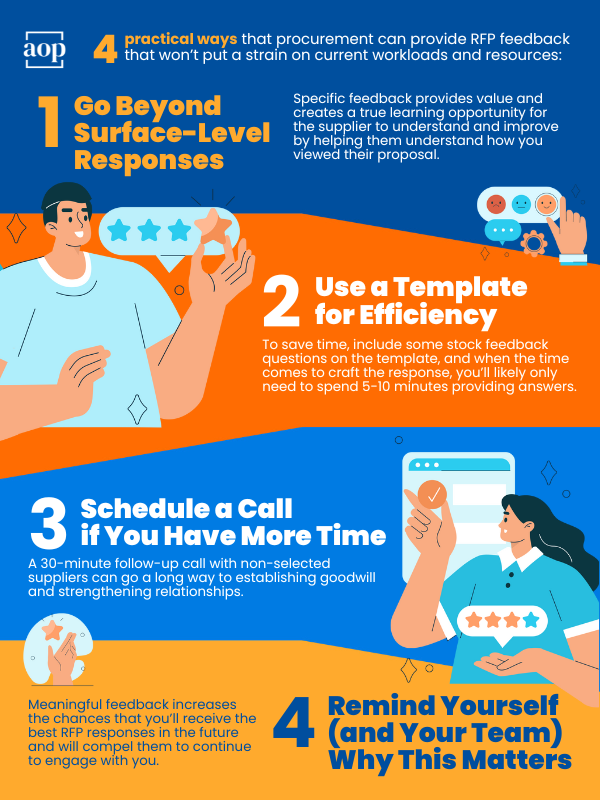
The first is a written feedback template, shared at the same time you communicate the decision. This takes about five to ten minutes per respondent if you've built notes during the evaluation. Use a consistent template with stock prompts so respondents get comparable, structured feedback and you're not starting from scratch each time. I'll give you the template structure in the next section.
The second is a 30-minute Q&A call with the respondent. This is more transparent and, paradoxically, often requires less preparation than a written template because the conversation does the work. The respondent can ask follow-up questions, you can address what they actually care about, and the richness of the insight you can offer in conversation is something a written template can't match. If you have the bandwidth, this is the option I'd recommend for any supplier you have a real ongoing relationship with or expect to compete in future processes.
Whichever format you choose, go deeper than the surface. "You were too expensive" or "another bidder scored higher" is not feedback. It's a brush-off. Real feedback gives the respondent something they can use to improve their next proposal, refine their messaging, or even rethink part of their offering.
The eight dimensions of meaningful RFP feedback
When I think about what meaningful feedback actually covers, there are eight dimensions worth addressing. You don't need a long paragraph on each one. A few honest sentences per dimension is enough. The goal is to give the respondent a clear, honest picture of how their proposal landed.
- Proposal strengths. What did you genuinely like about what they put forward? What stood out positively, even if they didn't win?
- Areas for improvement. Where did the proposal fall short of what you needed? Be specific. Vague feedback is unactionable.
- Perception change. Did the RFP process shift your view of the respondent, positively or negatively? Was there something in their submission, their team, or their engagement that changed how you see them as a potential partner?
- Technical solution. How did you assess the solution they proposed? Was it appropriately sized, technically credible, and well-matched to your problem?
- Delivery capability. Did you believe they could actually deliver the solution they proposed, on the timeline they committed to, with the team they put forward?
- Commercial competitiveness. How did their pricing and commercial model stack up, not just on absolute price, but on value, structure, and risk allocation?
- Cultural fit. Did the people you met feel like the right people to work alongside your team? Cultural fit is often the deciding factor in a tight race, and respondents rarely get told whether it was a factor at all.
- Competitive differentiators. What were the key things that made you choose the supplier you chose? This is the most useful piece of feedback you can give, because it tells the respondent what they're up against in the market.
You can build a feedback template around these eight dimensions in an afternoon, and you'll use it for years.
For more information on the importance of feedback, listen to Episode 696 of the Art of Procurement: Dear Supplier… The Art of Giving RFP Response Feedback.
An RFP template you can adapt
Below is a template structure you can tailor to your specific need. I've kept it deliberately concise. Every section here is one I'd expect to see in a competent RFP, and nothing more.
[Your Company]: Request for Proposal for [Project Name] Issue date: [Date] Response deadline: [Date, time, time zone] Primary point of contact: [Name, email]
1. About [Your Company] - A brief introduction to your organization: what you do, where you operate, the scale of the business, and any context the respondent needs to understand the environment they would be supporting. Two to three paragraphs is plenty.
2. Project background and objectives - The "why" behind this RFP. What problem are you trying to solve? What outcomes are you trying to achieve? What does success look like 12 months after the contract is awarded? Respondents who understand your goals write better proposals than respondents who only understand your specs.
3. Scope of work - The specific services, deliverables, or products you are asking the respondent to propose. Be as concrete as you can. Vague scopes produce uncomparable responses. Where you genuinely want the respondent to propose the approach, say so explicitly so they know they have permission to be creative.
4. Mandatory requirements - The non-negotiables. Certifications, geographic coverage, security or compliance requirements, language support, anything that would disqualify a supplier if absent. List these up front so suppliers can self-deselect rather than waste their time and yours.
5. Proposal requirements - What you want the respondent to submit. A typical structure includes:
- Executive summary (2 pages maximum)
- Proposed solution and methodology
- Implementation plan and timeline
- Proposed team, with named roles and CVs
- Three relevant case studies or references
- Pricing model and commercial terms
- Assumptions, dependencies, and exclusions
Specify page limits, file formats, and any required templates. Tell them what you don't want as well as what you do.
6. Evaluation criteria - How you will score the proposals, with weightings if possible. A simple, honest framework might be: technical solution (30%), delivery capability and team (25%), commercial proposal (25%), cultural fit and references (20%). Respondents who know how you're scoring write proposals that respond to your priorities.
7. Timeline and process - The dates that matter. Question deadline, response deadline, shortlist notification, presentation slots, decision date, target contract start. Respect the dates you publish; moving them after the fact damages trust.
8. Commercial terms - Pricing format you want to see (fixed price, time and materials, outcome-based, retainer), currency, payment terms, and any constraints. Attach your standard contract terms or link to them clearly. Do not make respondents hunt for your terms.
9. Questions and clarifications - A defined window and a single channel for questions. Commit to circulating all questions and answers to all participants so no respondent gets an information advantage.
10. Our commitment to you as a respondent - This is the section most RFPs don't have, and the one I'd most encourage you to include. State plainly that you understand the effort it takes to respond, that you will limit the field to a small number of qualified suppliers, that you will hold to the timeline you've published, and that every respondent will receive meaningful written feedback or a 30-minute debrief call regardless of outcome. Then deliver on it. This is how you become a client of choice.
Becoming a client of choice through process discipline
The argument I want to leave you with is a simple one: The way you run an RFP says more about your procurement function than almost any other process you'll run. Suppliers talk to each other. The way a supplier is treated when they lose travels faster than the way they're treated when they win.
If you keep the field small, communicate clearly, hold to your timeline, and deliver real feedback to everyone who participated, you build a reputation that makes the best suppliers want to compete for your work next time. Some of the strongest supplier relationships I've ever built started with feedback I gave to a supplier who didn't win. They remembered it, we worked together later, and the trust was already in place because of how the first process had been handled.
Codify the feedback step into your sourcing process. Build the template now, while you're not under deadline pressure. Make it a gate in your evaluation workflow. Five to ten minutes per respondent, captured incrementally during the evaluation itself, is not a heavy lift. The return, in supplier quality, market reputation, and the strength of the relationships you'll build over time, is disproportionately large.
That's what positioning procurement as a client of choice actually looks like in practice. Not a slogan, but a process.