
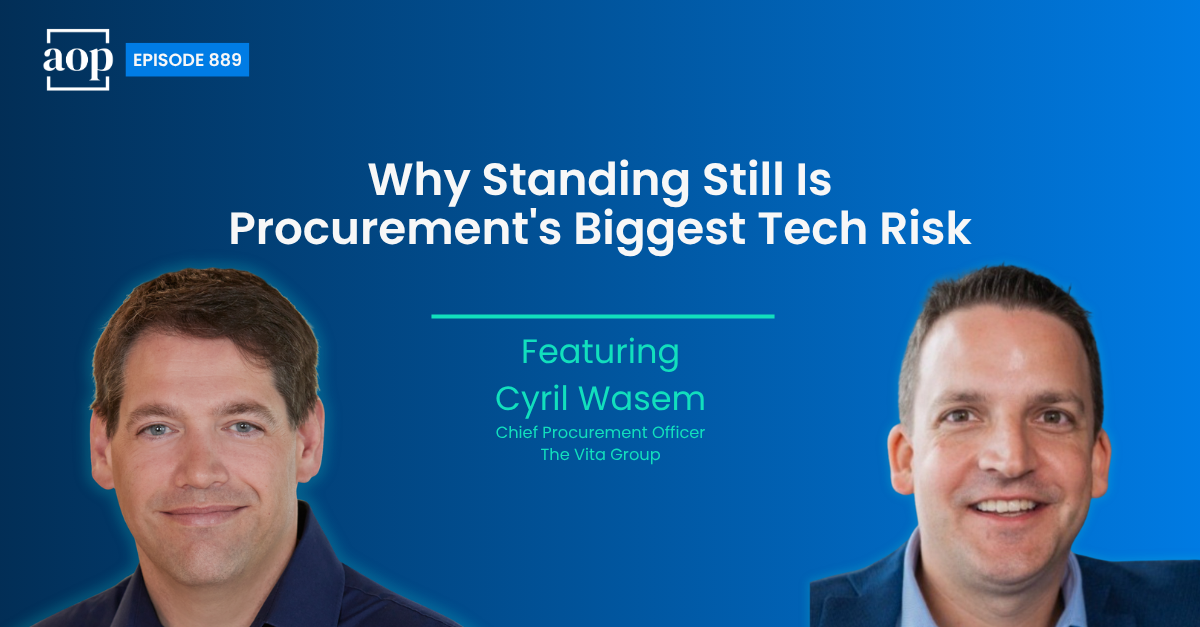
“Nowadays, if you stand still, that's actually the biggest risk.” -Cyril Wasem, Chief Procurement Officer, The Vita Group
Procurement technology is moving faster than most buying processes were built to handle. Every week brings new updates. The old playbook of long requirements phases and year-long rollouts now carries a real cost, because by the time you finish planning, the tools have already moved on.
Cyril Wasem is Chief Procurement Officer at The Vita Group, a global leader in polyurethane foam technology, and a judge on our ProcureTech100 program. In this conversation, he explains how he makes time for startups and why his team went live with an orchestration platform in eight weeks.
Get Into the Ecosystem While You Can Shape It
"If you close your eyes and you're not part of the procuretech environment, I think it's very dangerous, because now you're in a phase where you can influence how to develop solutions. You can be an early adopter."
A little over two years ago, Cyril noticed that the CPO role was absorbing all of his time. So he blocked Friday afternoons for one or two startup pitches.
His advice for everyone else is lighter. Set aside at least one or two hours a month to meet companies you haven't spoken with, and lean on your peers to filter the noise. The real payoff is influence. Teams that engage now help decide what these tools become.
Choose the People Behind the Product
"If you select to work with one, make sure it's not just a one-time implementation. It's rather the start of a joint development."
With so many good providers out there, Cyril sees selection as the hard part. He looks past the feature list to the team's mindset and culture. He also likes that startups rarely say no.
Features that sound nice don't count for much unless you can turn them into value together. For a CPO, that means bringing real problems to the table and treating the supplier relationship as a shared roadmap.
Phase One Doesn't Need to Be Perfect
"But that was phase one, and we already had, I would say, 80% of the benefits."
The Vita Group implemented an orchestration solution in eight weeks. Cyril knew from the start that it wouldn't be fully integrated on day one. Phase two brought in the remaining ERP systems. Phase three is now adding features tailored to their needs.
Getting there took a lot of push from Cyril. The business was used to detailed contracts and implementation plans. Private equity ownership helped, and so did knowing exactly what they wanted before they started.
Control Is the Start, Not the Goal
"You want to also bring added value back to the organization. So it matters what you're doing with those requests."
Before the platform, Cyril controlled indirect spend through a weekly control tower. It meant manual data preparation and slow approvals that nobody enjoyed. Now requests flow, and he can change a process step in two or three clicks.
He doesn't want procurement to be the policeman, though. That visibility only pays off if it leads to more tenders, fewer suppliers, and a real strategy for each area of spend.
Enrich Your Data Instead of Waiting to Clean It
"I have seen companies that have invested heavily in thousands of reports, but nobody has used the data."
The Vita Group's data is still fragmented and unstructured. Cyril isn't waiting for that to change. He sees the bigger jump coming from connecting and enriching data, such as linking market indices and import data with supplier metrics, and keeping it updated automatically.
Picture a chemical business with 30 sites and inconsistent raw material specifications. Connected data is what lets you find new suppliers without "two months and 70 emails" just to get samples.
Be Braver With Management
"I think procurement organizations still need to be a bit braver about raising what's possible, because it may not yet be fully visible to management teams what you can do with new technology."
This connects directly to talent. Cyril hires young graduates who will challenge the status quo, and he believes curious people stay when the company backs their ideas with budget. Making that case is procurement's job.
He's convinced that companies that treat procurement as a business function, not a back office, see better results on both the top and bottom line.
Links: