
3 min read
The State of AI in Procurement: Who’s Getting the ROI?
Philip Ideson : Updated on August 24, 2026
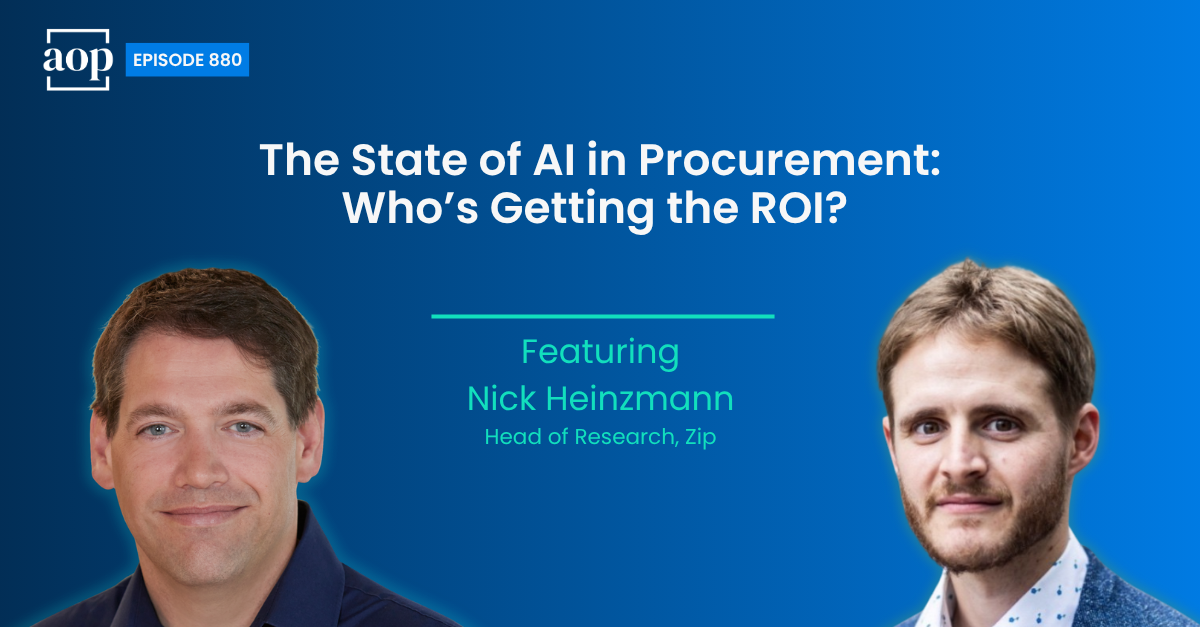
“There’s an absolute risk of procurement’s role and scope being diminished by AI, unless we embrace new ways of working.” - Nick Heinzmann, Head of Research, Zip
Everyone understands that now is the time to move with AI, but at the same time, there’s an understandable reluctance to move too quickly when the technology changes every few months, the rules of governance are still being written, and there are legitimate questions about data, security, talent, and ROI.
The problem is that waiting for those questions to disappear may be a strategy in itself, and probably not a very good one.
That was one of the things that struck me in my latest conversation with Nick Heinzmann, Head of Research at Zip. Nick joined me to discuss the findings from Zip’s 2026 State of AI in Spend report, and the data paints a fascinating picture of where procurement stands today.
According to their research, only 17 percent of respondents said they could demonstrate clear ROI from AI. When you look more closely at the organizations that are getting returns, some important differences emerge. They’re using AI more deeply, changing how work gets done, hiring for different skills, and becoming much more comfortable operating in an environment where the answers aren’t always obvious.
Procurement can become the nexus for enterprise AI
“Procurement has the opportunity to be the nexus of all these different things happening with AI, but there are also different and competing views on how this should be done or who should get that role.”
AI is creating questions that cut across technology, finance, risk, legal, operations, and the commercial side of the business. Very few functions naturally touch all of those areas, but procurement does.
That puts us in an interesting position. We already have experience evaluating suppliers, navigating competing stakeholder priorities, managing commercial relationships, and bringing governance to decisions that span the enterprise. AI gives us an opportunity to apply those capabilities to a much bigger business challenge.
AI ROI requires changing how the work gets done
“The depth changes the results because it requires actually refactoring how you work. And if you don’t refactor how you work, you can’t get the ROI from AI.”
There’s a temptation with any new technology to lay it over an existing process and call that transformation. AI makes that temptation even greater because you can often generate an immediate productivity improvement without changing much else.
Zip’s data suggests that the organizations getting measurable returns are going further. They’re reconsidering processes, changing roles, and moving people away from work that AI can increasingly handle.
If we automate part of someone’s job and leave everything around it untouched, there’s only so much value available. We have to redesign the work itself and deliberately move human capacity toward areas where judgment, relationships, commercial thinking, and problem solving create more value.
Shadow AI can tell leaders where to look
“Rogue AI use or ungoverned AI use is a signal of demand. It shows where people want to use a tool, where they’re expecting benefit.”
There are genuine security and governance concerns with employees using unsanctioned AI tools. Nobody is suggesting that organizations simply open the gates and allow people to put sensitive information wherever they like, but there’s information hidden in that behavior as well.
If people are repeatedly going around an approved process to use AI, I’d want to understand why. What are they trying to accomplish? Where is the existing process creating friction? What capability do they believe they’re missing?
Shutting the rogue behavior down may address the immediate governance issue. Understanding the demand behind it gives us something much more useful: a potential roadmap for where automation could make work better.
Evaluating AI output is becoming a core skill
“The bottleneck actually becomes, how do we verify what’s useful and what’s good, and then actually apply it.”
This is a topic I feel quite strongly about because I spend a lot of time using these tools myself. Generating something with AI is easy. Knowing whether the answer is good is considerably harder.
The value comes from going backward and forwards with the tool, challenging assumptions, asking better questions, bringing different perspectives into the analysis, and then applying your own human experience and judgment to whatever comes back.
For example, in our conversation, Nick shared that the ability to evaluate AI output was the number one skill respondents were looking for when hiring. I think that tells us a lot about where AI literacy is heading, and not only for procurement. Prompting may get someone started, but, ultimately, human judgment determines whether the output deserves to influence a sourcing strategy, supplier decision, negotiation, messaging, or recommendation to the business.
The five-year transformation roadmap is losing relevance
“The three-to-five-year mindset [for technology] assumes that you will get to sequence these things in a nice orderly way. And the data doesn’t really say that.”
We’ve been conditioned to build multi-year roadmaps. Define the future state, establish the sequence, and work methodically toward it. That becomes much harder when the capabilities available six months from now could materially change what you would choose to build today.
Nick’s research found planning horizons moving closer to six months or a year, particularly among organizations further along in AI adoption. I don’t see that as short-term thinking. I think it’s a recognition that our plans need to accommodate a much higher rate of change now… more than ever before.
There still needs to be a long-term direction of travel. Procurement leaders still need principles, priorities, and a clear understanding of the business outcomes they’re pursuing. But we should become much more comfortable revisiting how we get there now and in the short term.
Links: