
4 min read
The AI Pilot Phase is Over: How to Move From AI Investment to Genuine Business Impact
Philip Ideson : August 16, 2026
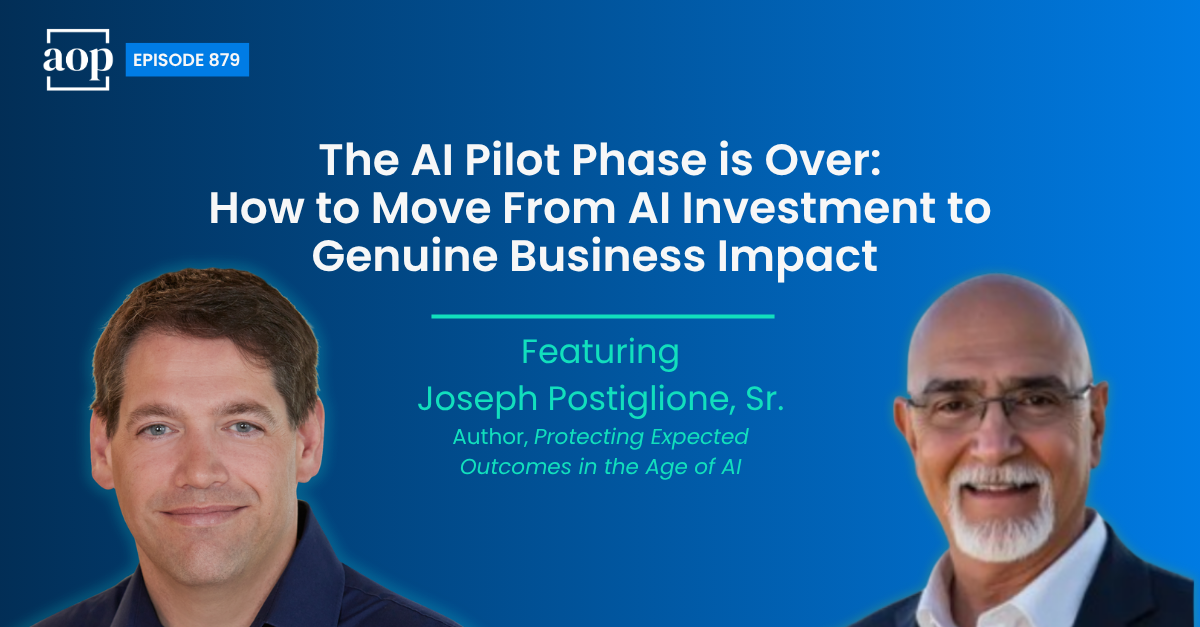
“If you're not completely sure about what you want to try to achieve, how will you know you ever achieved it?” - Joseph Postiglione, Sr., Author, Protecting Expected Outcomes in the Age of AI: Why AI Implementation Must Evolve - And the Emergence of Commercial Control
AI has created a sense of urgency inside almost every organization. There is pressure to experiment, pressure to invest, and increasingly, pressure to show results.
That last piece is where things get especially interesting for procurement and where there is so much opportunity still on the table. I've spoken with plenty of procurement leaders who know they may only get one real opportunity to secure meaningful investment in new technology. If the promised ROI doesn't materialize, getting funding for the next idea becomes much harder. With AI, we're already seeing organizations accumulate pilots that never quite make it into production or deliver the value everyone expected when they were approved.
So, what happens between the business case and the outcome?
That question was at the heart of my recent conversation with Joseph Postiglione, author of Protecting Expected Outcomes in the Age of AI: Why AI Implementation Must Evolve – And the Emergence of Commercial Control.
Joseph believes traditional technology implementation methodologies leave an important gap. They're designed to get the technology implemented, but they don't necessarily give organizations a way to continuously protect the business outcomes that justified the investment in the first place. His concept of "commercial control" is intended to close that gap.
Start by getting very specific about the outcome
"Let's get clear about expected outcomes. If it's savings, what is the generation of the savings?"
I've seen my fair share of business cases over the years, and one of the easiest traps to fall into is creating an outcome that looks precise on a spreadsheet but rests on assumptions that aren't nearly as precise.
Savings are a perfect example. We can negotiate a lower price and build a savings projection around it, but what happens when demand changes? What happens when the business changes? The original calculation may no longer hold.
Joseph's point is that this thinking has to happen before implementation. Define exactly where the expected value will come from, understand what could change it, and establish how you're going to know whether it's actually materializing. That creates a much stronger foundation than simply agreeing on a headline ROI number.
Efficiency only matters if you know what you'll do with it
"If we're saying that we're going to save 10,000 man hours over the course of this implementation, how are you going to evaluate that? What do we do with those 10,000 hours that you're saying that you're going to save and how does that manifest itself into value to the enterprise?"
We talk a lot about freeing capacity so that people can move to "higher-value work," but unless we've defined what that higher-value work is and created a plan to redirect people's time toward it, we've only completed half the equation.
If AI gives a procurement team thousands of hours back, we should know how we intend to reinvest them before those hours become available. Category expansion, deeper stakeholder engagement, supplier innovation, or better commercial decision making may all be opportunities. The important part is being deliberate about it. Otherwise, an efficiency business case can quickly become little more than a headcount conversation.
Knowing you're off target isn't enough
"It's going to be important to know not that I'm missing my target, but why have I missed my target? What's actually happened that's caused me to miss this target?"
Most organizations are already capable of looking backward and determining whether an investment delivered against its targets. By that point, however, you've potentially lost months of value and may have very few options left to correct course. The more useful question is what changed along the way.
Understanding why an outcome is drifting gives leaders an opportunity to act while the investment can still be protected. That turns measurement from an exercise in explaining past performance into a management tool for shaping what happens next.
Procurement has an opportunity to enter a much bigger conversation
"The road to getting a seat at the table has never been easy. And so you have to put yourself into the fire a little bit, risk a position that may not be the easiest to try and espouse, only to get your point across."
I've spent much of my career talking about how procurement can get involved in business decisions earlier. AI creates another opportunity to do exactly that.
Every function is going to make technology investments, negotiate commercial agreements, evaluate business cases, and wrestle with whether those investments are delivering. Those are areas where procurement already has relevant skills.
We shouldn't wait for someone to formally invite us into those conversations. We need to understand what the business is trying to accomplish, bring a useful perspective, and be willing to put ourselves into discussions where procurement may not traditionally have participated. As Joseph said, once you have a win in your column, the road gets a little easier.
Plan for the outcome as deliberately as the implementation
"I have to plan and design my expected outcomes and that has to be a part of the implementation plan."
Organizations put enormous effort into implementation plans. We establish timelines, resources, technical requirements, integrations, milestones, and governance. Joseph's argument is that the outcomes themselves deserve the same level of intentional design.
I think that's particularly relevant as we enter the next phase of enterprise AI adoption. The novelty of "doing something with AI" is disappearing quickly. Executives are going to become much more interested in what those investments produced.
That creates both a responsibility and an opportunity for procurement. We can bring greater commercial discipline to our own AI investments, but we can also apply that expertise across the enterprise. And for procurement leaders looking for ways to expand their influence, helping the business figure out how to do this at scale is a very good place to start.
Links: