

2 min read
The Agentic Procurement Diaries: Reverse Intake: Procurement Without the Form
Philip Ideson : November 25, 2026
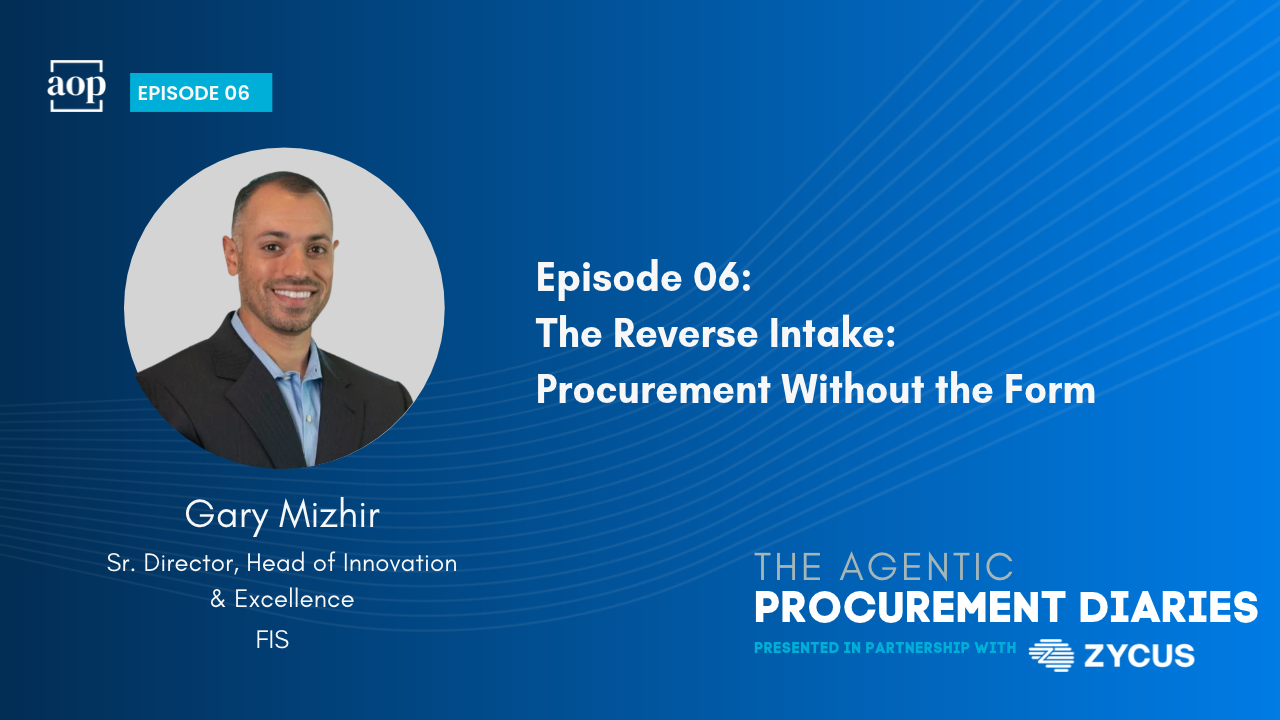
Dear Diary… "I foresee a world where we never do an intake ever again, because we already know the information before somebody has to come ask and fill out a form."
Gary Mizhir is a Senior Director and Head of Innovation & Excellence at FIS. He started as a Navy Supply Corps officer, moved through consulting into corporate procurement at Capital One, and spent time in roles outside the function before coming back to procurement at FIS.
Today he runs digital and AI strategy plus policy and governance, data and analytics, and supplier management. He calls the job a bit chief of staff and a bit strategy. What struck me in our conversation is how far past task automation he is willing to think.
The Inheritance
FIS grew through M&A, and Gary told me the supply chain grew organically along with it. The company hit an inflection point where it had to get its arms around that spend and make the cost base more efficient while it modernized its platforms.
Procurement sits within finance at FIS, one of several homes they have had since Gary joined. The business historically saw them as the team out there to do deals, and they usually got engaged too late.
The Bet
The first bet he made was cultural. Driven by their CPO, the team raised their hand for work they had not traditionally done, and nobody turned them away. Gary dislikes fixing late engagement by throwing more governance at people; he would rather speak up with the right intention and then deliver.
His second bet is on scope. He sees agents that replace human tasks as limited and asks whether whole steps can go away. His example is the competition waiver, whose spirit is a healthy supply chain, real competition, and lower costs.
If agents watch the market every day, Gary thinks that spirit can be met another way. He wants a "reverse intake," where procurement goes to stakeholders already knowing what they buy, how suppliers have performed, and what the market is doing.
The Agentic Question
I asked Gary where he would let an agent act with no human in the loop. His answer was focused on when: eventually. He uses AI best when he already has a hypothesis to confirm or reject, and when he has no idea of the answer, he does not simply trust it.
He did name candidates. He doesn't think procurement needs all the manual reviews of POs and invoices, because AI can do that. He also pictures a "mother agent" orchestrating the others, with self-serve workflows that feel decentralized while guardrails run in the background.
His worry is the gut check. Experienced people can spot when AI is wrong today. He told me about his phone dying in London, finding his way without it, and realizing his three teenagers would still be sitting on the side of the road.
The Receipt
What has worked: The enterprise backs AI investment, so in his words, they are not pushing a boulder uphill. Procurement now gets pulled into work and is more linked with the commercial team than ever.
Selling the vision works when it starts with pain points business leaders already feel, like driving cost out and tying datasets together. He compares it to a band that slips one or two songs off the new album in among the hits.
What has not worked yet: the roadmap scares some of his team, and someone asked him the morning we spoke whether it meant losing their job. The full vision is not built, and he says plainly they are not there yet.
His advice was one word: start. New capabilities no longer take six to eight months to bring on, and he finds that comfort with small tools opens people to bigger ones.
Links:
- Gary Mizhir on LinkedIn
- Zycus on LinkedIn
- AOP Provider Directory | Zycus
- Subscribe to the AOP Newsletter