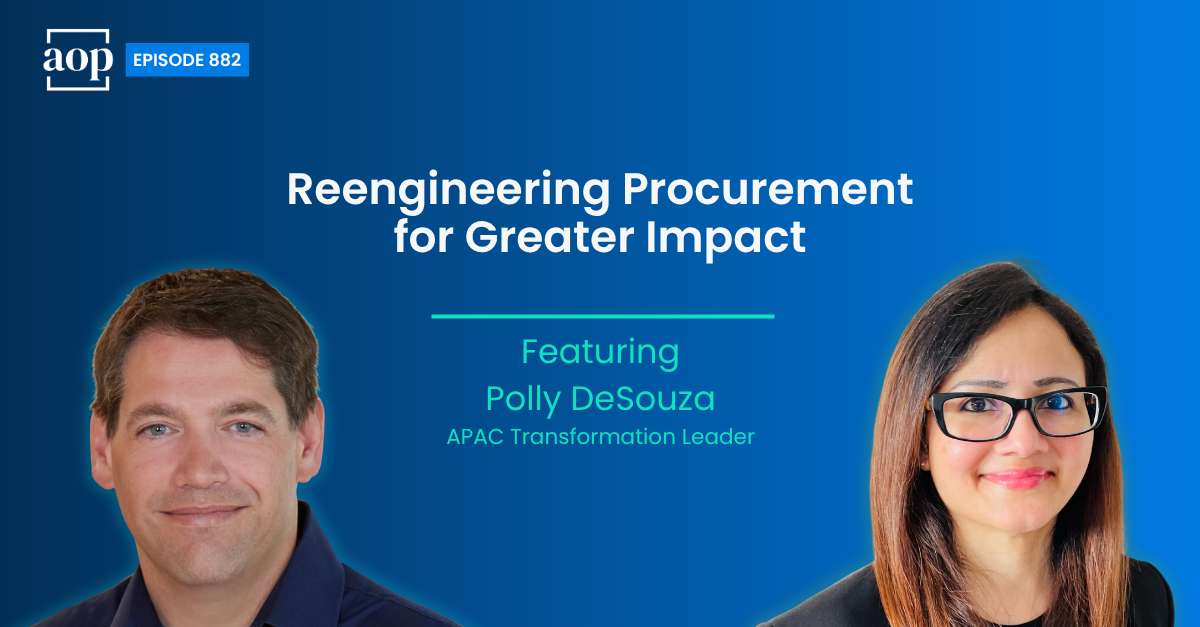
“If you want a seat at the table, you’ve got to pull up the chair.” - Polly DeSouza, APAC Transformation Leader
For years, procurement has said that tactical and transactional work keeps our teams from spending enough time on category strategy, supplier relationships, market intelligence, and the bigger business problems where procurement can make a real difference. AI now gives us a credible opportunity to change that, but removing work from someone’s plate doesn’t automatically prepare them to do something different with the time they get back.
That was one of the themes discussed in my recent conversation with Polly DeSouza. Polly has worked on both sides of transformation, first as a consultant and then from within the organizations responsible for making change stick. That experience has given her an interesting perspective on what separates a transformation that looks good on paper from one that actually changes how procurement operates.
Procurement has to learn the language of the business
“Procurement needs to understand the financial language, needs to understand the business language in order to provide a more valuable and meaningful conversation while dealing with business users or even dealing with finance.”
I’ve always believed that our ability to influence the business depends heavily on our ability to communicate in terms the business cares about. Savings will always matter, but procurement leaders need to understand how their decisions connect to the P&L, growth, risk, working capital, and the broader objectives of the organization. Instead of asking stakeholders to understand procurement’s priorities, we need to understand theirs and show how procurement can help achieve it all.
Transformation requires internal selling
“You’ve got to be a good salesperson within the organization to really sell the transformation that you want to and articulate it well to actually solve a business problem and bring those benefits to the table.”
Consultants are brought in because someone has already decided their perspective has value. Internal transformation leaders don’t always have that advantage. You have to create belief in the change you’re proposing. That means having the data and analysis behind your case, but it also means being able to explain why the change matters to the people whose behavior, support, or investment you need.
Earlier involvement is one of the best measures of influence
“How early is procurement brought into the conversation with the business?”
If procurement consistently hears about an initiative after the supplier has been chosen, our stakeholders are telling us something about how they perceive our value. When they involve us while they’re still defining the need, evaluating the market, or considering their options, they’re telling us something very different.
That kind of involvement can’t be mandated into existence. It grows when people have experienced procurement bringing useful intelligence, ideas, judgment, and problem solving to previous conversations. Over time, being invited in earlier becomes evidence that the relationship itself has changed.
AI creates capacity, but teams still have to move beyond their comfort zones
“If the collective consciousness of the organization is to not challenge the status quo and to remain in the same lane, then we aren't actually pushing people up the curve to challenge themselves and to bring in that value.”
We’ve spent years asking for more capacity. Now we have technology capable of creating some of it. But people who have spent 10 or 15 years becoming excellent at sourcing or other familiar activities aren’t automatically going to redirect their time toward supplier management, deeper category work, or new forms of business partnership.
Leaders have to make that transition possible. That means building skills, creating opportunities to practice them, and giving people permission to move beyond the work that has historically defined their roles. Otherwise, we risk creating efficiency without capturing the larger opportunity behind it.
Start transformation with the problem you’re trying to solve
“What’s the business problem that we’re trying to solve? Or what’s the enterprise value that we want to bring to the table?”
There is an enormous amount of change happening in procurement, particularly around AI. It’s easy to feel pressure to move simply because everyone around you appears to be moving. Before choosing a technology, redesigning a process, or launching another transformation program, be clear about the problem and the value you expect to create. From there, decisions about people, process, systems, and governance have something concrete to anchor to.
That discipline is going to become even more important as the number of technologies and possibilities available to procurement continues to grow.
Clearly, this next phase of procurement transformation will ask something different of us. Technology can remove work and create capacity, but it can’t decide what procurement should become with that capacity. That part is still ours.
We have to develop people who are comfortable learning and changing, build relationships that bring us into important conversations earlier, and keep connecting our transformation decisions to problems the business genuinely needs to solve. If we can do that, the time AI gives back to procurement could become one of the most valuable resources we have.