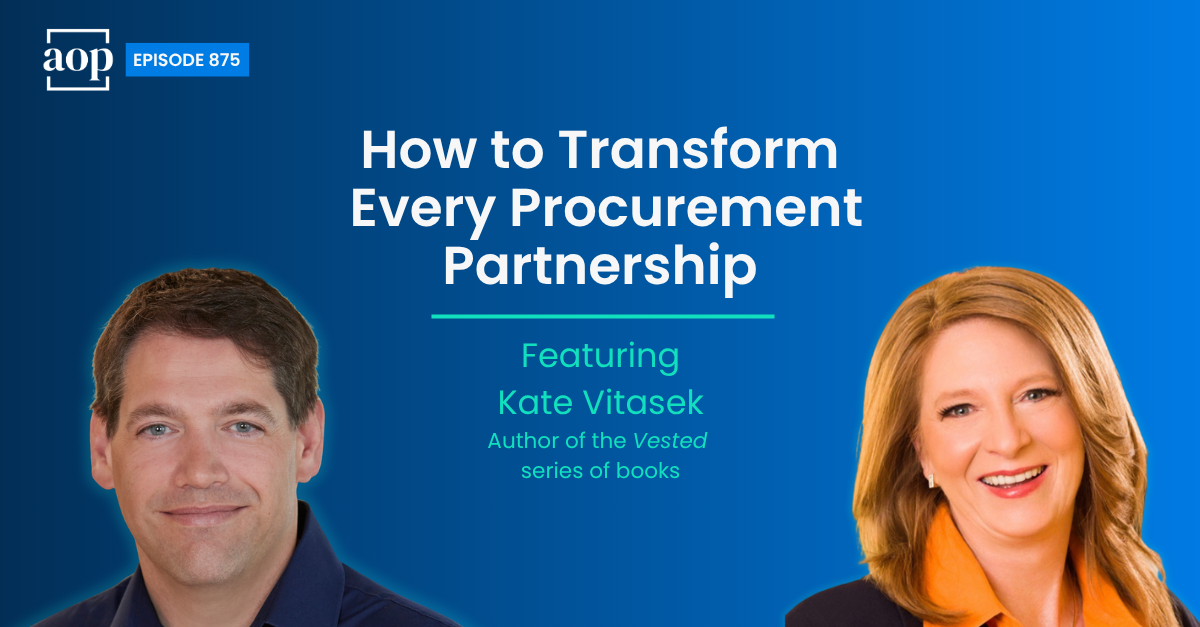
“When you have a great partnership, the value that you can create is unbelievable if you know how to do it.” - Kate Vitasek, Author of the Vested series of books
Strong partnerships don’t happen by luck or accident. Procurement spends a lot of time thinking about their suppliers, contracts, negotiations, and performance metrics, but one thing I've learned over the years is that none of those elements, on their own, determine whether a partnership succeeds.
The best supplier relationships aren't built on perfect contracts. They're built on trust, transparency, shared objectives, and a willingness to adapt as circumstances change. In this week’s Art of Procurement podcast episode, I welcome Kate Vitasek back to talk about how procurement can accomplish this… every time.
Kate has spent more than two decades researching what separates successful partnerships from those that fall apart. Through her work at the University of Tennessee and Vested, she's helped organizations rethink how they design relationships, structure agreements, and create value together.
Our conversation centers on her latest book, The Vested Way: Five Rules for Achieving the Impossible. While the ideas originated in large outsourcing relationships, they can be applied broadly. Whether you're managing a strategic supplier, working across an internal ecosystem, or collaborating with business stakeholders, the same principles hold true.
Partnerships Fail Long Before the Contract Does
"A McKinsey study looked at joint ventures and alliances and found that 38 percent of those failing cite lack of trust. They also said that 35 percent of partners misallocate efforts on the deal terms versus governance."
Procurement has traditionally invested enormous energy in negotiating contracts. They spend weeks, sometimes months, refining terms, allocating risk, and trying to anticipate every possible scenario. Kate suggests we may be investing that effort in the wrong place.
Once the contract is signed, the real work begins. Without governance that allows both parties to stay aligned, even the strongest agreement will eventually lose relevance.
Shared Outcomes Change Everything
"Rule one is to focus on outcomes versus transactions... We have to come up with a shared vision. We think of it as a statement of intent. Otherwise, you're going to be pulling at each other."
Too many supplier relationships begin with a scope of work instead of a shared objective. One side is measured on delivering services. The other is measured on controlling costs. Everyone is technically doing their job, but they're working toward different definitions of success.
Kate uses the analogy of climbing Mount Everest together, and I think it's a powerful one. When both organizations are committed to reaching the same destination, conversations naturally become more collaborative and, as a result, more productive. Decisions become easier because they're evaluated against a shared outcome rather than individual interests.
Culture Isn't a ‘Soft’ Issue
"If cultural fit is important and the survey is telling us we don't have it, how are we going to close the gaps? The supplier was measured on the plan they put together to help close those gaps."
Supplier selection has become increasingly sophisticated. Procurement teams evaluate technical capability, financial health, ESG performance, cybersecurity, and dozens of other factors. But culture often receives far less attention because it feels difficult to measure.
Rather than treating cultural fit as something you either have or don't have, she described organizations that intentionally identify the gaps and work together to close them. That mindset changes culture from an abstract concept into something procurement can actively manage.
AI Should Strengthen Relationships, Not Replace Them
"The mistake that I fear is that people are trying to automate the relationship. Instead, you should be automating the work underneath the relationship and doubling down and investing more in the relationship."
There's understandable excitement about what AI can automate across procurement. Many repetitive, transactional activities are ideal candidates for automation, and organizations should absolutely embrace those opportunities. What AI shouldn't replace are the conversations, trust, creativity, and joint problem-solving that define strategic partnerships.
If anything, automation should create more capacity for procurement to spend time with suppliers, understand business challenges, explore new ideas, and strengthen collaboration.
Procurement Needs More Deal Architects
"My goal is that over time you're going to see more and more procurement organizations move away from buying and selling to be what we call deal architects."
As organizations become more dependent on strategic suppliers, ecosystems, and outcome-based partnerships, procurement's role extends well beyond negotiating price or managing contracts.
They’re increasingly being asked to design commercial models that encourage innovation, align incentives, share risk appropriately, and create value for everyone involved. Those are very different skills from simply running a sourcing process.
The best procurement leaders understand contracts, certainly, but they also understand business strategy, re lationship design, governance, incentives, and collaboration. They become architects of partnerships that create value long after the sourcing event has finished.