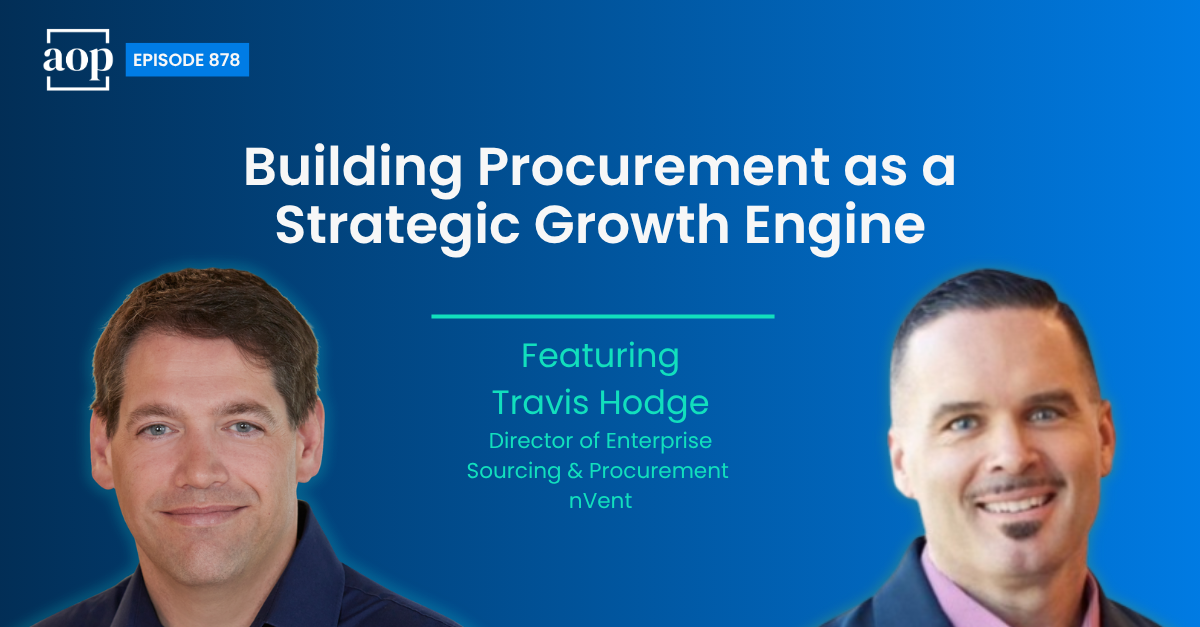
“Procurement’s future is bright, when we continue to do it the right way for the right reasons.” - Travis Hodge, Director of Enterprise Sourcing & Procurement at nVent
One of the things I enjoy most about recording conversations at industry events is hearing in person how procurement leaders are solving many of the same challenges in very different ways.
Technology may dominate the agenda, but when you get beyond the product demos and keynote presentations, the conversations usually come back to something much more fundamental: how do we help procurement become a more valuable partner to the business?
Travis is the Director of Enterprise Sourcing and Procurement at nVent, and he's leading a transformation that goes well beyond implementing new technology. His team is building what he calls a "supplier experience," redefining procurement's relationship with the business, and creating an operating model that positions sourcing as a strategic growth engine rather than a transactional service.
Throughout our discussion, Travis returns to the fundamentals. AI, automation, and digital transformation all have an important role to play, but they only create lasting value when they're built on strong partnerships and leadership that people trust.
Supplier experience deserves a seat alongside customer and employee experience
"There are three experiences at nVent. Employee experience, customer experience, but over the decades, supplier experience hasn't been a focus point, and it is now for nVent."
Supplier experience is something we talk about far less than customer experience, yet procurement depends on it every day.
I appreciate that Travis doesn’t describe supplier experience as another initiative layered onto procurement's responsibilities. For his team, it has become the organizing principle behind their transformation. Instead of asking how procurement can improve internal efficiency, they're asking how they can become better partners and ultimately create more value for everyone involved.
Strategic relevance has to be earned
"Twenty-five years of sourcing and procurement, and the one thing that I've learned over and over and over again is you have to become strategically relevant."
Procurement leaders often ask how they can earn a ‘seat at the table.’ Travis offered a simple answer: connect everything you do back to the business strategy. That sounds obvious, but it's surprisingly easy to lose sight of. Procurement teams naturally become immersed in sourcing events, supplier negotiations, contracts, and savings targets. Meanwhile, executive leaders are thinking about growth, investment, shareholder returns, and competitive advantage. Bridging those two conversations is the straightest line to making procurement strategically relevant.
Transformation needs permission to succeed
"One of the greatest things that the executive leadership team did for me was to give me a hall pass. You have to get that top-down support from day one."
I think this is a brilliant way to describe executive sponsorship. Transformation inevitably requires people to challenge long-standing processes and established ways of working. Without visible support from leadership, those efforts may stall before they gain momentum. A leader's "hall pass" creates space to ask difficult questions, redesign broken processes, and spend time understanding the business before rushing into solutions. That's something procurement transformations often underestimate.
AI should remove friction before it creates intelligence
"We want to take the work out of work. We need to take the work out of work for both the supplier and ourselves and the customer so it's easy to do business with us."
There's enormous excitement around agentic AI and predictive capabilities, and rightly so, but many procurement teams still spend too much time on repetitive, administrative work that creates frustration for buyers and suppliers alike. Reducing that friction has immediate value. It improves supplier relationships, lowers the cost of serving the business, and gives procurement professionals more time to focus on work that actually requires judgment.
Leadership begins with genuine care
"Don't act like you care. Care."
Transformation programs often focus on systems, governance, roadmaps, and operating models. Those things matter. But people determine whether change succeeds.
Employees know the difference between leaders who genuinely care about their development and those who simply manage performance. That trust is especially important during periods of significant change, when uncertainty is high and expectations continue to grow.
Technology will continue to reshape procurement over the coming years. New platforms will emerge. AI capabilities will evolve. Operating models will continue to change.
What won't change is the importance of earning trust, building strong partnerships, staying connected to business strategy, and leading people with authenticity. Those fundamentals have always mattered, and after my conversation with Travis, I'm more convinced than ever that they'll continue to define the procurement leaders who create the greatest impact.