
4 min read
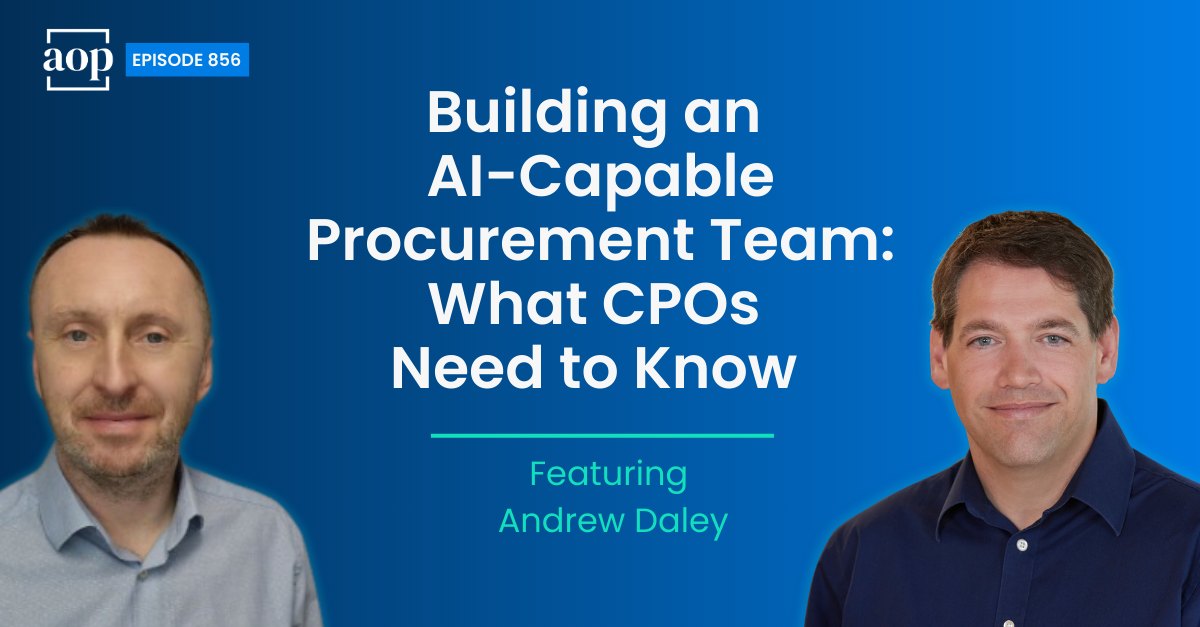
Building an AI-Capable Procurement Team: What CPOs Need to Know
Philip Ideson : March 8, 2026
“The winners will be the people who make it happen themselves. The losers will be the ones that just bury their heads in the sand.” -Andrew Daley, Managing Director, Digital Procurement and Supply Chain at Edbury Daley
Procurement is standing at a genuine inflection point. For years, we have talked about digital transformation, automation, and doing more with less. Now AI has accelerated that conversation in a way that feels different. The urgency is real. The implications for our teams are real.
The choices we make over the next few years will shape what procurement looks like for the next decade.
That is why I invited Andrew Daley back to the podcast. Andrew sits at a fascinating intersection. As Managing Director of Digital Procurement and Supply Chain at Edbury Daley, he works across technology vendors, consultancies, and procurement teams.
He sees who is hiring, what skills are in demand, and how leaders are thinking about the future. Our conversation focused on one core question: how do we build AI-capable procurement teams before the market forces the issue?
AI Has Shifted the Skills Conversation
“AI has been the keyword or phrase in our market, and that’s really shifted the skills discussion. A lot more people are now actually taking note that things are going to change and evolve. Previously, we were preaching about the need to develop skill sets, and people were saying, yeah, but we’ve got much bigger priorities.”
This comment struck me because it reflects what I am hearing in my own conversations with CPOs. For years, skills development often sat behind cost savings targets, risk mitigation, and transformation roadmaps. Now AI is forcing a reprioritization. Leaders are realizing that technology investment without human capability is a hollow strategy. The conversation has moved from “should we upskill?” to “how quickly can we upskill?”
The Tech Skills Gap Is Real
“Most organizations would say they've already got enough tech. Some of it's good, some of it's improving, but what they lack is that human capability to use it strategically.”
We have more technology than ever. Many organizations would admit they already have powerful tools that are underutilized. The constraint is not access to AI. It is the capability to integrate it, question it, and apply it in ways that create advantage. Strategic thinking, data literacy, adaptive intelligence, and confidence working alongside AI are emerging as differentiators. If we do not intentionally build those capabilities, we risk creating a procurement function that owns sophisticated tools but struggles to extract meaningful value from them.
Planning to Upskill Is Not the Same as Doing It
“We don't necessarily see enough of those skills around data literacy, orchestration, critical and strategic thinking, and the confidence to embrace AI effectively. I think people are planning to invest in upskilling, but I don’t think many have.”
That honesty matters. I hear a lot of ambition when it comes to AI readiness. I hear far fewer examples of structured, funded, measurable upskilling programs. The gap between intent and action is where competitive advantage is created. The leading functions Andrew referenced have already started experimenting with new learning pathways, redefining roles, and aligning talent strategy with digital strategy. Others are still asking what the future should look like. The time to move from discussion to execution is now.
The Talent Profile Is Changing
“A clear profile’s emerging for me: intellectual curiosity. The people who are really thriving are personally proactive. They’re investing in their own futures. They’re more comfortable experimenting with technology, and they’re not feeling threatened by the AI.”
The most successful procurement leaders I know share two traits: vulnerability and curiosity. They are willing to admit they do not have all the answers. And they are relentlessly curious about what might be possible. In the AI era, that mindset is becoming a prerequisite. Skills can be developed. Mindset is harder to teach. As CPOs, we need to hire for curiosity and reward those who experiment, learn, and share.
Training Budgets and the Risk of Underinvestment
“Training budgets have been vulnerable for a long period of time. And I think it's back to the credit crunch personally. I think it went out of fashion, and it's never really gotten back in fashion. But again, the conversation that I'm having is that people recognize something's got to be different this time around. In terms of the ROI question, I think productivity is the key thing.”
This is an uncomfortable truth. Technology budgets often grow while training budgets remain flat. The result is predictable. Tools are implemented, adoption stalls, and ROI disappoints. Andrew made the point that productivity, cycle time, risk reduction, and transformation readiness are all legitimate ROI measures for skills investment. If we want AI to deliver on its promise, we have to fund the human side with the same rigor we apply to business cases for software.
The Current State of AI Adoption
“We’ve done our own AI readiness diagnostic. 51% are experimenting with pilots, 5% are scaling across processes, and 14% say they’ve got AI embedded in workflows. But 30% percent haven’t even started yet.”
This data tells a clear story. Many teams are in pilot mode. Very few have scaled AI across processes. A significant minority have not begun. That suggests we are still early in the adoption curve. It also highlights a risk. If we remain in perpetual pilot mode, we create what one consultant described to me as “pilot purgatory.” Experimentation without scaling does not transform operating models. At some point, leaders must make deliberate choices about embedding AI into core workflows and redesigning roles accordingly.
Take Ownership of Your Development
“If you're going through an interview now, you're being interviewed by a CPO or the procurement leader, and they're saying, ‘What have you done on digital transformation?’ and you say, ‘Here’s what I’ve done to prepare myself. I’ve taken it on myself.’ I would argue that right now, that is a very desirable quality to hire for.”
This is advice I would echo to any procurement professional. Do not wait for your organization to design the perfect development program. The resources to learn about AI, data analytics, and digital orchestration are more accessible than ever. Personal initiative signals future leadership potential. For CPOs, hiring individuals who demonstrate that ownership mindset is one of the most practical ways to future-proof your team.
Digital and Talent Strategy Must Be Intertwined
“Your digital strategy and your talent strategy have to be intertwined.”
If there is one line that captures the essence of our conversation, this is it. We cannot treat AI adoption as a technology project and talent development as a separate HR initiative. They are interdependent. If AI is part of your competitive strategy, your skills roadmap must run in parallel. Otherwise, the technology will go live, adoption will stall, and the promised value will evaporate.
Procurement has a rare opportunity right now to shape our own future. AI can relieve pressure from overloaded teams, elevate our strategic contribution, and redefine our value proposition. But none of that will happen by default. It will require intentional investment in skills, courageous rethinking of operating models, and leaders who are willing to move before the market forces them to.
The tipping point is coming. The question is whether we are preparing our teams to be on the right side of it.
Links: