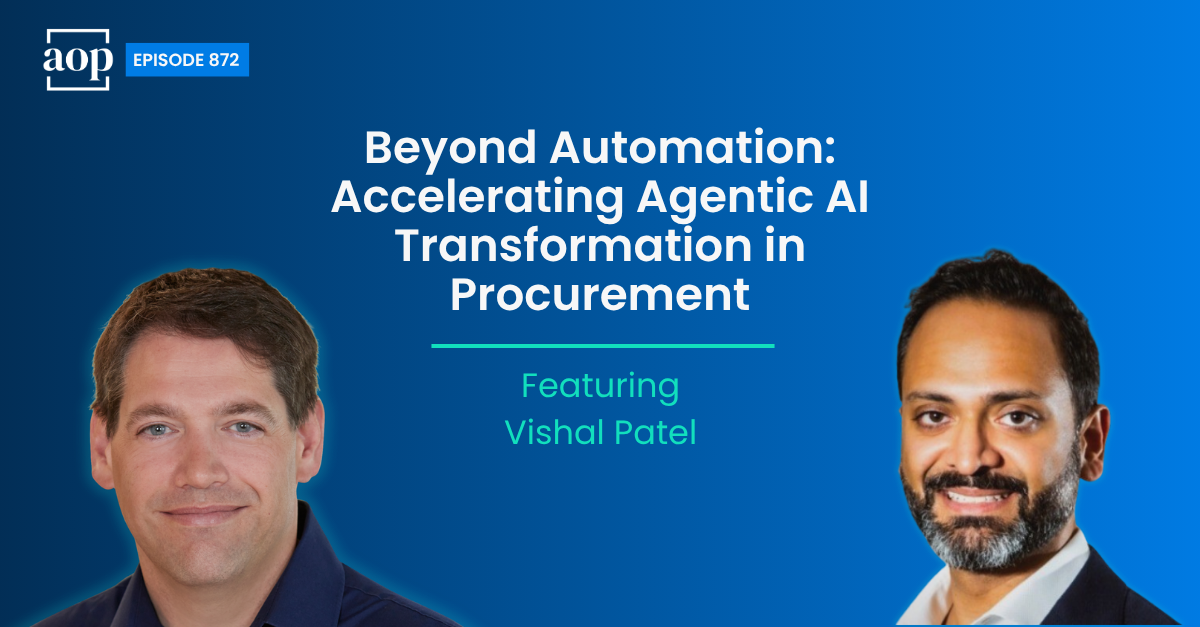
“The future of procurement isn't actually AI. It's people using AI to improve business outcomes and improve their own value add.” - Vishal Patel, SVP Product & Customer Marketing at Ivalua
For the last two years, the procurement AI conversation has largely revolved around possibilities.
What can AI do? Which tools should we use? How quickly will it change… everything?
Those are still important questions, but I increasingly find that the procurement leaders thinking about AI in the best way are asking something different: how do we move from experimentation to long-term, scalable adoption?
While there is no shortage of AI pilots, proofs of concept, and ambitious visions, the real challenge is turning AI into something that consistently creates value. That means building trust in these new capabilities while also helping teams understand how AI fits into the way they work every day.
I recently spoke with Vishal Patel, SVP of Product and Customer Marketing at Ivalua, about what he's seeing across organizations that are successfully accelerating their AI journey. Rather than focusing on grand transformation programs, Vishal emphasizes starting small and treating AI as a capability that grows over time.
The Organizations Moving Fastest Start Small
“They stopped viewing agentic AI as one big giant thing. Actually, they view it as many, many, many small things. They're looking for quick wins. That's how they were able to get adoption fast because they used AI to create some value, and they did it quickly.”
One of the biggest mistakes I see organizations make is treating AI as a single transformational initiative.
That approach often creates unrealistic expectations and makes it harder to demonstrate value early. Vishal's point is that successful organizations are breaking AI down into smaller opportunities where they can create measurable impact quickly.
The significance of those early wins goes beyond the results themselves. They build confidence and momentum. Most importantly, they help users become comfortable incorporating AI into their day-to-day work.
Procurement Is Still About Relationships
“At its core, procurement is about relationships with your stakeholders, relationships with your suppliers.”
The more we talk about automation, agents, and digital transformation, the easier it becomes to focus entirely on technology. Yet the core purpose of procurement remains unchanged.
The best procurement organizations are still built on trust, influence, collaboration, and relationships. What AI changes is how much time procurement professionals have available to invest in those activities. If AI can reduce the administrative burden of chasing approvals, answering routine questions, or managing transactional work, then procurement teams can spend more time where they create the greatest value.
Technology may change how work gets done, but it doesn't change why procurement exists.
Your AI Strategy Is Your Data Strategy
“I like to think that an AI strategy is a data strategy. They're not separate things. They are the same thing.”
Few topics come up more frequently in AI conversations than data.
For years, procurement leaders have worried about data quality. Many still do. The risk is that imperfect data becomes a reason to delay progress indefinitely.
Vishal acknowledges a reality every procurement leader already knows: no organization has perfect data. The question is whether you have a plan to continuously improve it while moving forward.
Organizations that treat data as a strategic asset will find it much easier to scale AI. Those who treat data quality as a one-time project may struggle to unlock AI's full potential.
Trust Is Built Through Transparency
“Having a level of transparency is what's going to build the confidence.”
Trust remains one of the biggest barriers to AI adoption.
Procurement teams are accountable for decisions involving suppliers, contracts, risk, compliance, and spend. It is understandable that they want to understand how AI arrived at a recommendation before they act on it.
What Vishal describes is something I have experienced personally while using AI. Confidence grows when you can see the reasoning, test the outputs, provide feedback, and watch the system improve over time.
The organizations that build trust most effectively are not asking people to blindly accept AI-generated outcomes. They are creating environments where users can learn alongside the technology and gradually increase their comfort level.
Skills, Not Agent Sprawl
“We had 50 agents that were doing some very specific things, and we've seen that a lot in the market. It was becoming a little bit of a ‘who has the most agents’ battle. And I think that's the wrong fight to have.”
According to Vishal, more AI agents don’t automatically create more value. Early in the AI journey, it was easy to be impressed by the sheer number of agents an organization could deploy. Now, the conversation is becoming much more sophisticated and focused on capability.
Vishal describes a shift toward fewer, more versatile agents that can leverage a broad set of skills, operate within governance guardrails, and adapt to different business needs. That approach is easier to scale, easier to manage, and ultimately more sustainable.
For procurement leaders, there is an important lesson here. The goal should not be building an army of narrowly defined bots. The goal should be creating a trusted AI capability that amplifies the expertise of the team and helps people make better decisions at scale.