

7 min read
AI is changing procurement first by changing what procurement teams spend their time on, and only a minority have gone further and rebuilt the function around it. That is the headline from new research by HFS Research in partnership with Art of Procurement. Of the 73 procurement executives surveyed, 15 percent say they have fundamentally reimagined procurement with AI at the core, while 38 percent are still running only pilots and proofs of concept.
The research also shows where AI is delivering value today, which benefits leaders care about most, what is holding adoption back, and how procurement leaders expect their roles to change over the next three to five years. HFS Research paired the findings with five moves it recommends for chief procurement officers.
About the AOP and HFS Research survey
HFS Research, in partnership with Art of Procurement, surveyed 73 procurement executives to understand how AI is reshaping the procurement function: where it is delivering value and where it is stalling. The sample is senior and enterprise-heavy:
- 73 procurement executives across nine industries
- 90 percent at VP level or above
- 78 percent at companies with $1 billion or more in annual revenue
Saurabh Gupta, president of HFS Research, presented the interim results at Art of Procurement’s Catalyst | San Francisco on May 5, 2026, where HFS Research was the event’s research partner. All percentages below come from that interim data set unless another source is named and linked.

Finding 1: Procurement is trapped in execution
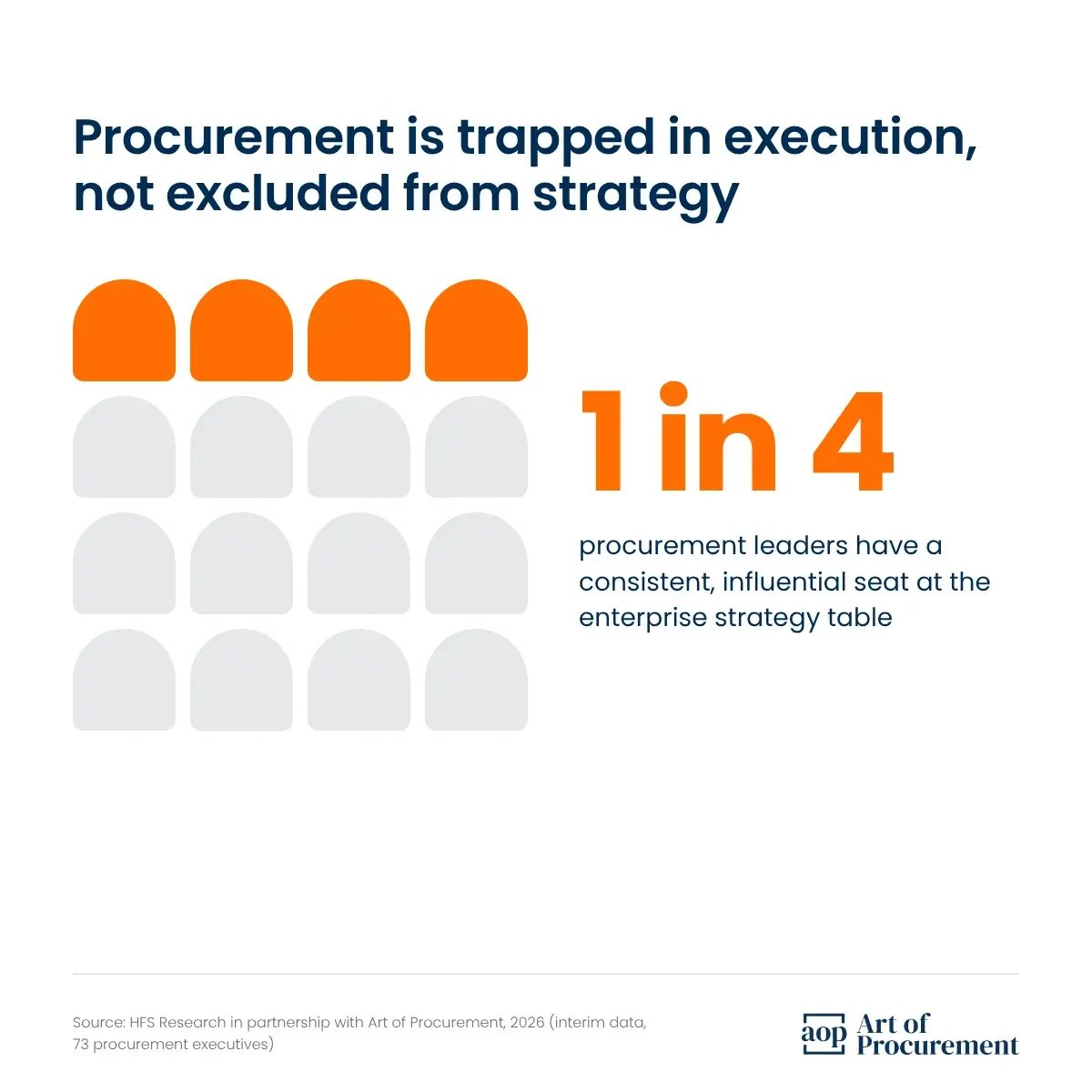
Only one in four procurement leaders say they have a consistent and influential seat at the enterprise strategy table.
HFS Research reads this as a capacity problem. In the words of the presentation, procurement “is not excluded from strategy. It is trapped in execution.” Procurement teams have long talked about becoming more strategic and finding a stronger voice, yet much of their week goes to transactions, processes, and operational firefighting. That context explains why so many leaders see AI as a way out. If AI absorbs the repetitive work, procurement professionals have more room for the strategic conversations they want to lead.
Finding 2: Most AI in procurement is still stuck in pilots
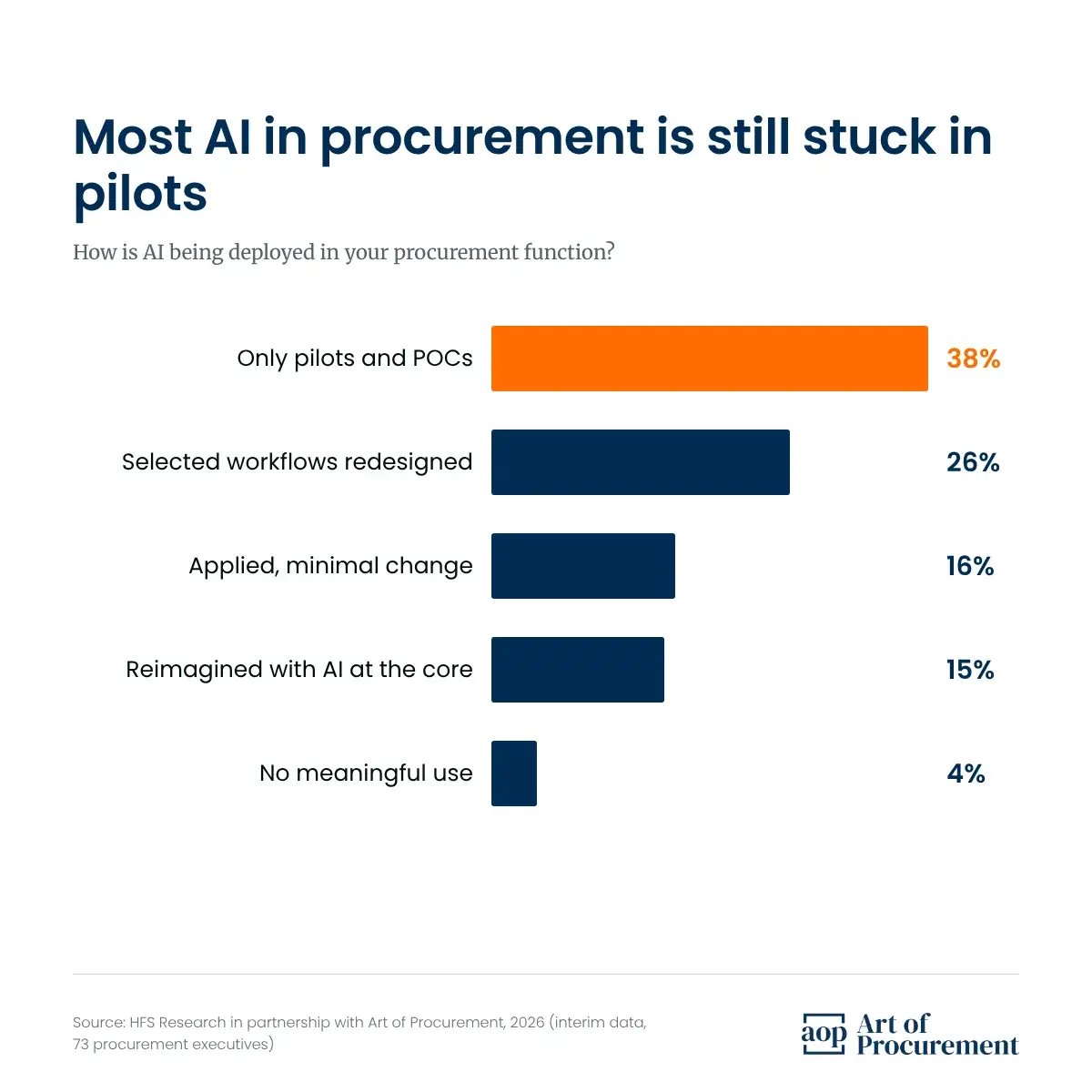
Asked how AI is being deployed in their procurement function, the largest group of respondents (38 percent) said they run only pilots and proofs of concept. Another 16 percent have applied AI with minimal change to how work gets done.
|
How AI is deployed |
Share of respondents |
|---|---|
|
Only pilots and proofs of concept |
38 percent |
|
Selected workflows redesigned |
26 percent |
|
Applied with minimal change |
16 percent |
|
Reimagined with AI at the core |
15 percent |
|
No meaningful use |
4 percent |
HFS Research calls this “pilot purgatory,” or “death by a 1,000 POCs.” The finding is consistent with other 2026 research. The Hackett Group reports that only 12 percent of organizations have large-scale AI implementation, even though 43 percent are actively pursuing deployment. The 2026 ProcureCon CPO Report found that 11 percent of procurement leaders are implementing AI with measurable impact and 65 percent are piloting.
What sets the AOP and HFS data apart is the middle of the distribution. Roughly four in ten respondents have moved past experiments (26 percent have redesigned selected workflows and 15 percent have reimagined procurement entirely), which shows that scaling AI in procurement is already achievable.
Finding 3: The top AI use cases are strategic, not transactional
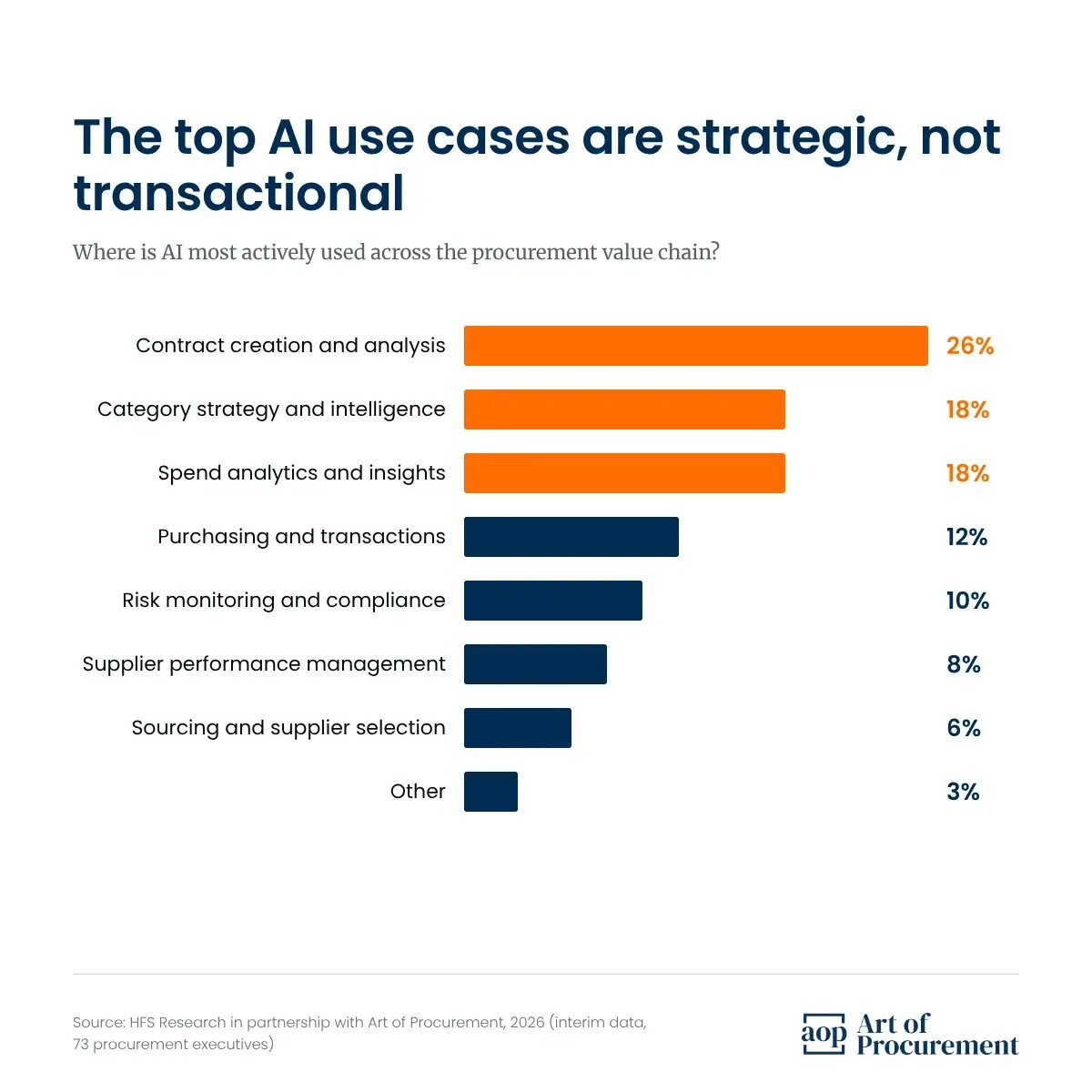
When asked where AI is most actively used across the procurement value chain, respondents put contract creation and analysis first.
- Contract creation and analysis (26 percent)
- Category strategy and intelligence (18 percent)
- Spend analytics and insights (18 percent)
- Purchasing and transactions (12 percent)
- Risk monitoring and compliance (10 percent)
- Supplier performance management (8 percent)
- Sourcing and supplier selection (6 percent)
Three percent named other areas. The top three use cases account for 62 percent of active use, and all three involve judgment as well as processing. That may surprise anyone who expected AI to start with purchase orders and invoices. These are areas where generative AI’s strength with unstructured documents and data pays off quickly, and where faster analysis gives procurement more to bring to stakeholder conversations. For a broader view of the tools behind these use cases, see our article on the state of AI in procurement.
Finding 4: Leaders value people outcomes over cost savings
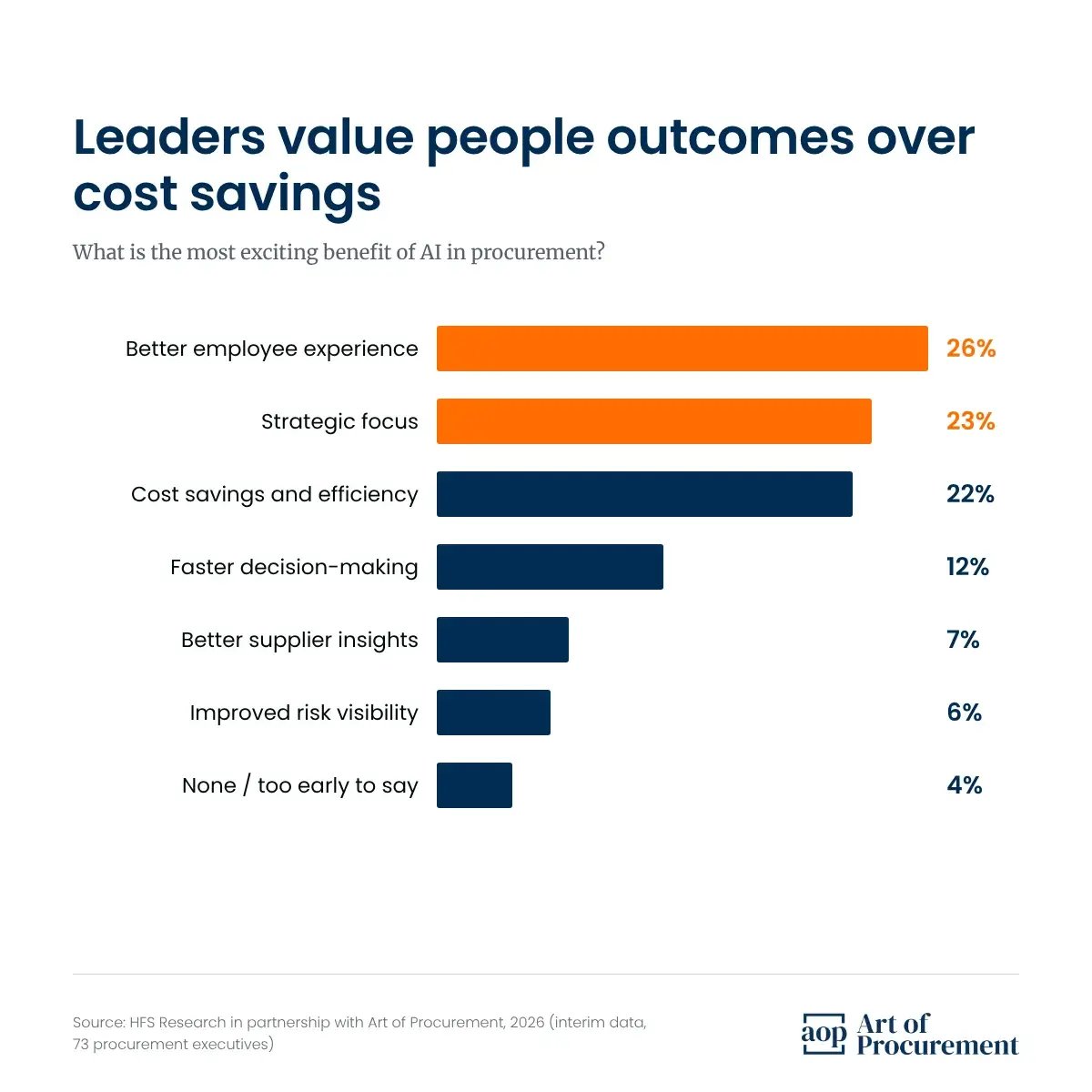
Asked for the single most exciting benefit of AI in procurement, respondents put a better employee experience first.
- Better employee experience: 26 percent
- Strategic focus: 23 percent
- Cost savings and efficiency: 22 percent
- Faster decision-making: 12 percent
- Better supplier insights: 7 percent
- Improved risk visibility: 6 percent
- None or too early to say: 4 percent
Almost half (49 percent) put a better employee experience or a more strategic focus first. HFS Research summarizes it this way: “AI takes over the repetitive. Humans move up the value chain.” For a function that has measured itself on savings for decades, it is notable that cost reduction came third.
Finding 5: The barriers sit around the technology
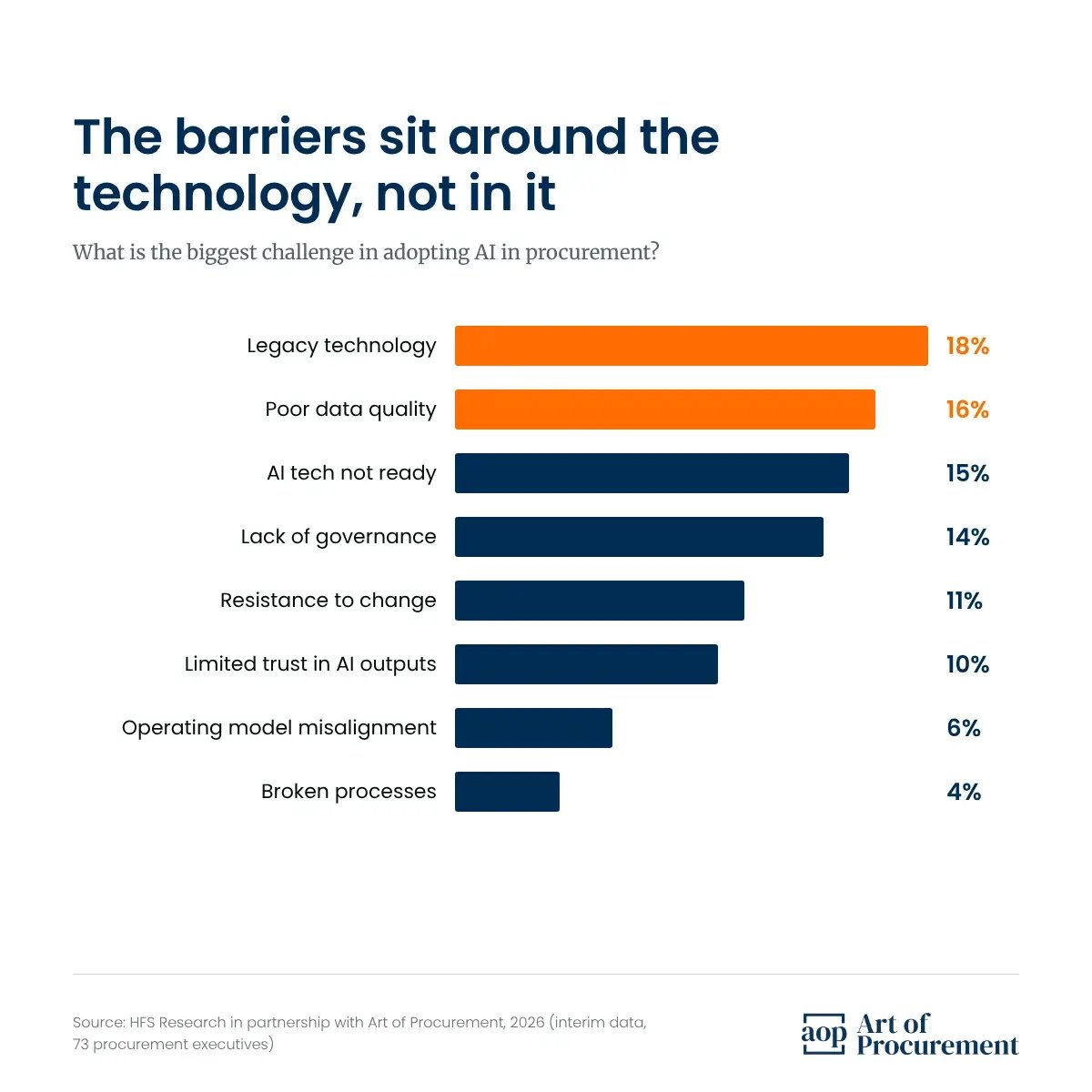
Legacy technology was the most frequently named single biggest challenge in adopting AI in procurement, at 18 percent. Poor data quality followed closely at 16 percent.
|
Biggest challenge |
Share of respondents |
|---|---|
|
Legacy technology |
18 percent |
|
Poor data quality |
16 percent |
|
AI technology not ready |
15 percent |
|
Lack of governance |
14 percent |
|
Resistance to change |
11 percent |
|
Limited trust in AI outputs |
10 percent |
|
Operating model misalignment |
6 percent |
|
Broken processes |
4 percent |
Only 15 percent blame the AI itself. The rest of the list describes the environment AI has to work in, from old systems and messy data to missing governance and people who are not yet ready to change how they work. HFS Research calls these “enterprise debts,” the silent killers of AI ambitions, and advises leaders to “stop obsessing over AI tech” and first fix what is broken around it. Data is a common thread across studies; in GEP’s 2026 survey of European CPOs, 77 percent cite poor data infrastructure and quality as a barrier.
Finding 6: AI is reshaping roles faster than operating models change
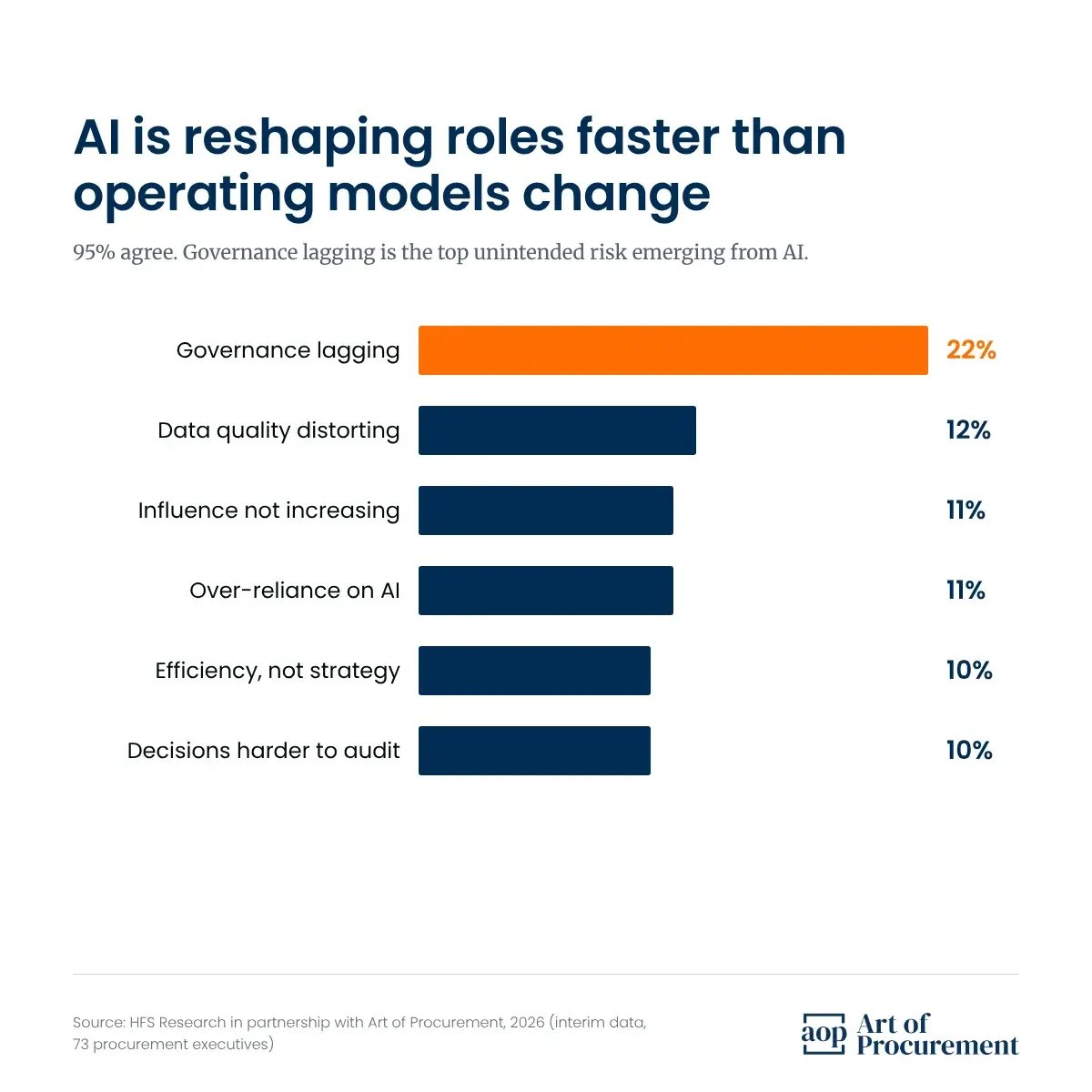
Nearly all respondents (95 percent) agree that AI is reshaping roles faster than they are redesigning their operating model. Asked which unintended risks are emerging from AI in procurement, they named:
- Governance lagging: 22 percent
- Data quality distorting outcomes: 12 percent
- Procurement’s influence not increasing: 11 percent
- Over-reliance on AI: 11 percent
- Efficiency gains that are not strategic: 10 percent
- Decisions that are harder to audit: 10 percent
- Roles becoming blurred: 7 percent
- New risks emerging: 6 percent
- Unclear accountability: 6 percent
Governance lagging is cited nearly twice as often as any other risk. Gartner’s research shows the same pressure from the leadership side: only 36 percent of CPOs are very confident in their ability to redesign roles and processes around AI. My AI governance framework for procurement offers a starting point for closing this gap, and our article on procurement operating models covers the structural choices involved.
Finding 7: The future of procurement is human plus machine
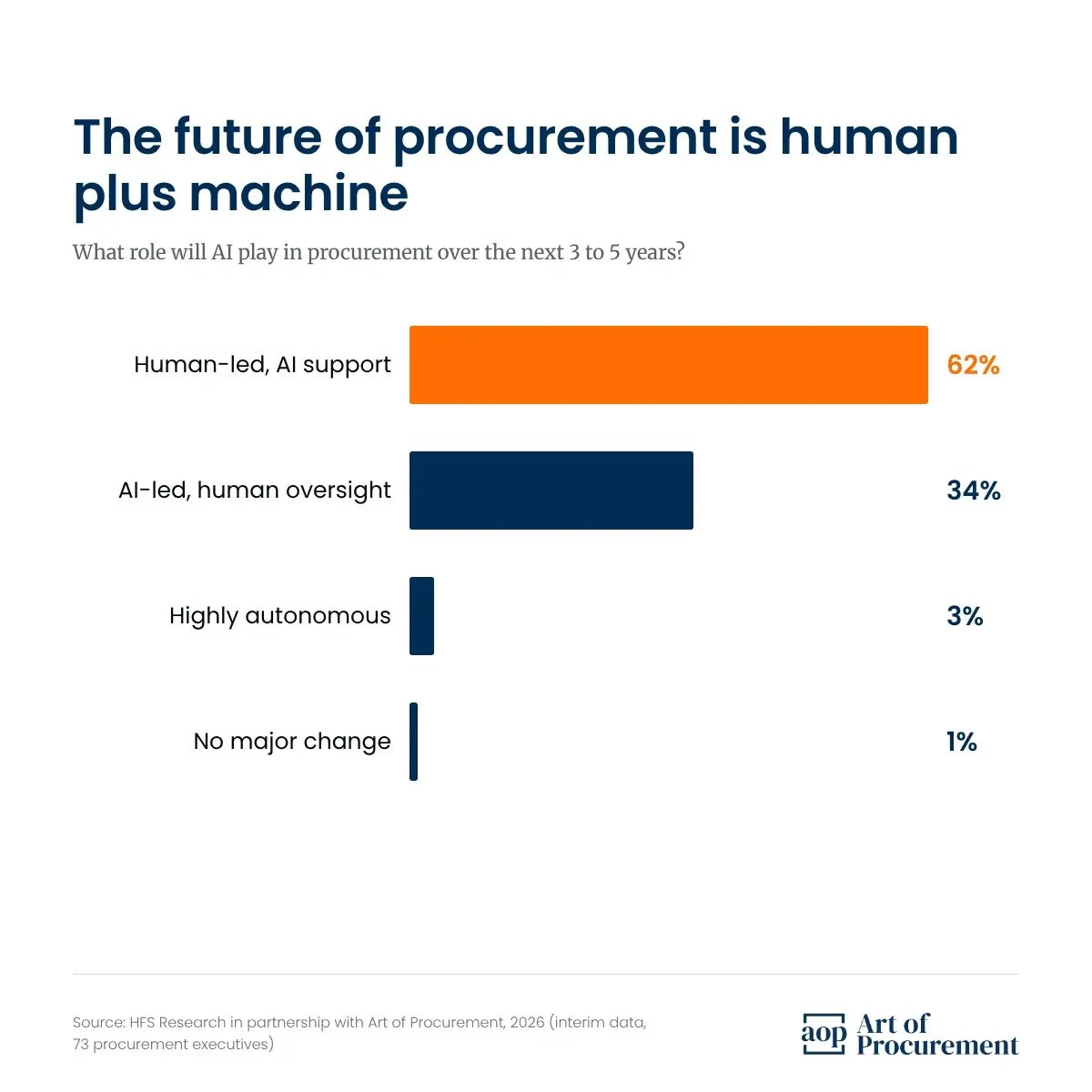
Asked about the role of AI in procurement over the next three to five years, most respondents expect people to stay in charge. Only 3 percent expect procurement to become highly autonomous.
|
Role of AI in procurement |
Share of respondents |
|---|---|
|
Human-led, with AI support |
62 percent |
|
AI-led, with human oversight |
34 percent |
|
Highly autonomous |
3 percent |
|
No major change |
1 percent |
In total, 96 percent see the future of procurement as human plus machine. HFS Research concluded that “AI will not replace procurement. But procurement professionals who don’t use AI will be replaced.” The more useful question for leaders, in HFS’s framing, is “whether your people will be ready to lead alongside it.”
The one-third who expect AI to lead with human oversight are worth watching. As agentic AI systems mature, more routine sourcing and buying decisions could shift to AI agents, with procurement professionals setting the rules and reviewing the exceptions.
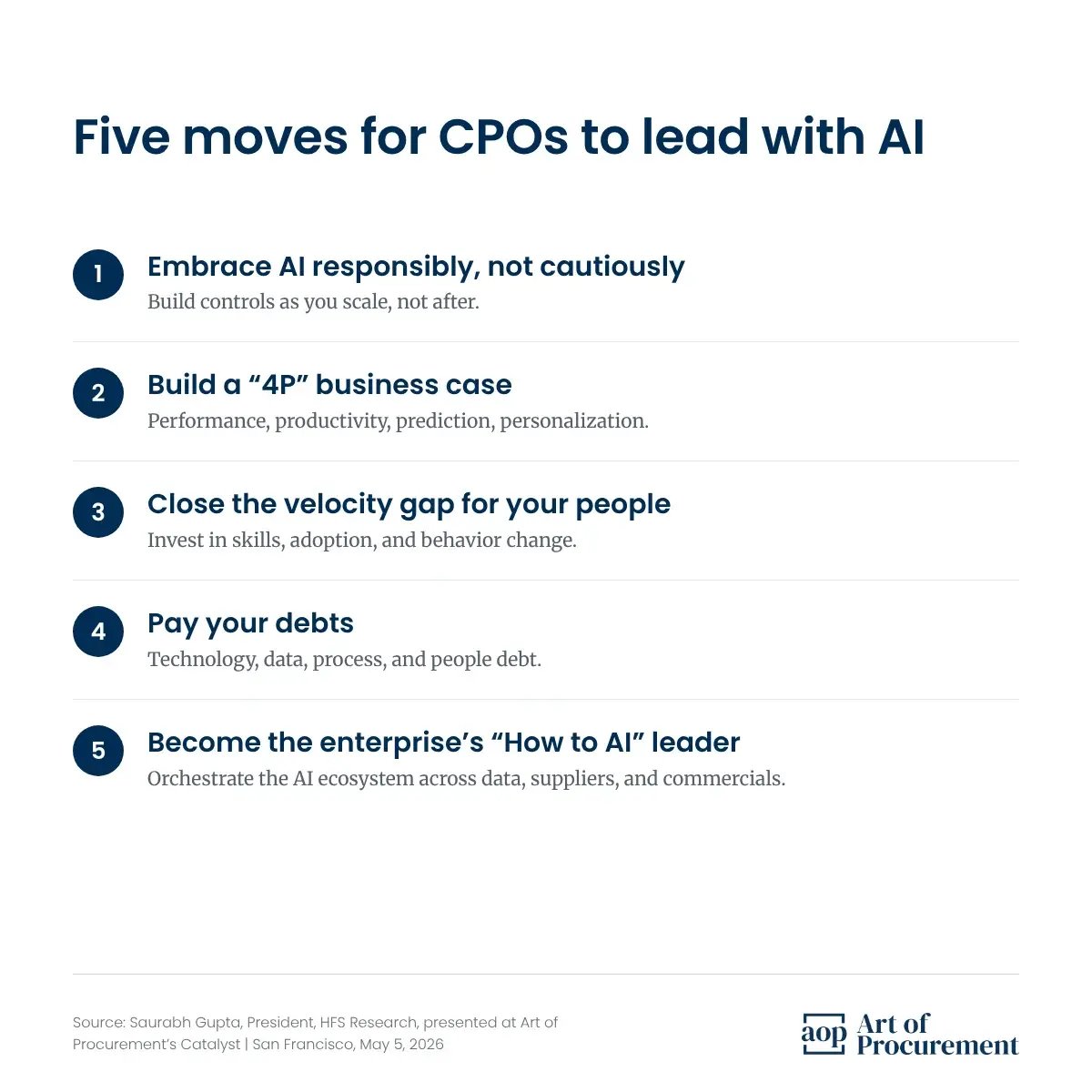
What CPOs should do next: five moves from HFS Research
HFS Research framed its recommendations as a mandate for CPOs: “If AI is a once-in-a-generation opportunity, then this is a once-in-a-generation leadership test.”
1. “Embrace AI, responsibly, not cautiously”
Move fast, and build controls as AI scales. Given that governance lagging is the top emerging risk in the survey, this means designing oversight into each deployment from the first day.
2. Build a “4P” business case
HFS Research recommends judging AI initiatives on performance, productivity, prediction, and personalization, and warns leaders not to “get obsessed with cost savings and efficiency.” Across 979 GenAI and agentic AI use cases HFS has collected over the past 12 months, productivity made up 54 percent of pilots but only 19 percent of use cases in production. Performance outcomes, such as competitive advantage and new revenue, grew from 8 percent of pilots to 27 percent of production use cases. Business cases built on efficiency alone are more likely to stay in pilot.
3. Close the “velocity gap” for your people
Individuals adopt AI quickly in their personal lives, where there is little friction and fast payback. Enterprises move slowly because of siloed systems, undocumented workflows, compliance debates, and unclear liability. In HFS Research’s words, “Your best employees are already AI-augmented… While your enterprise is forming committees.” Closing that gap means investing in skills, adoption, and behavior change as well as in tools.
4. “Pay your debts”
Technology debt, data debt, process debt, and people debt all slow AI down. The survey’s barrier data makes this concrete, since legacy technology and poor data quality together account for 34 percent of the biggest challenges named.
5. Become the enterprise’s “How to AI” leader
Procurement sits at the intersection of data, suppliers, and commercials. HFS Research encourages CPOs to own that position and become the orchestrator of the AI ecosystem across the enterprise, including how AI solutions are bought, governed, and commercially structured.
The bottom line on how AI is transforming procurement
The AOP and HFS Research findings describe a function at a turning point. Procurement leaders know why they want AI, and they are using it for strategic work such as contract analysis and category strategy. Most have not yet redesigned how procurement operates around it, and governance is lagging behind adoption. The teams that move beyond pilots are likely to be the ones that treat AI as a leadership and operating model challenge, build business cases on more than savings, and pay down the technology, data, process, and people debts that hold AI back. Humans will stay in the lead; the work now is preparing them for it.
